About Me

My photo
I am a Shark and Big Animal Photographer and the Founder of Big Fish Expeditions. I also pilot research submersibles on rare occasions but primarily I photograph sharks and rays. The shark images that I take have been used in many commercial publications but most importantly I try to concentrate on shooting rare and endangered species of sharks for conservation initiatives. It is a labour of love.
Showing posts with label cabo. Show all posts

Sunday, December 20, 2009

The Shark Tour Blogs: Back to Baja, Great whites and Makos

The Shark Tour Goes Full Circle

September 25, 2009 by sharkdiver

The Shark Tour Goes Full Circle

August 23rd 2009

We made it back to So Cal. After a four day drive across the USA from the far north east to the extreme south west we arrived in San Diego exhausted but ready for some serious shark hunting. I’m happy to say that our camper held up fine even at 12,000ft when we crossed the Rockies. After an epic 24,000km round trip from Southern Baja, up the west coast of California, across to the Gulf of Mexico, around Florida, back to the Gulf, up the east coast to the very eastern tip of the Gaspe Peninsula in Canada, down to Ontario and diagonally back to the Baja border, our VW (which now has almost 350,000km on the clock) is purring like a kitten.

The night we arrived in San Diego we jumped straight in at La Jolla shores to wash the desert out of our eyes and reacquaint ourselves with the leopard sharks. True to form, there were dozens of leopards swimming around in the surf zone, as well as a bunch of shovelnose guitarfish and some very cute pint sized bat rays.

We spent the next few days trying to figure out where the soupfin sharks were hiding but alas they eluded us. Cryptic reports of sightings came in from a number of local divers but other than a quick glimpse of a shadowy caudal fin, we free dove, scuba dove and snorkeled in vain.

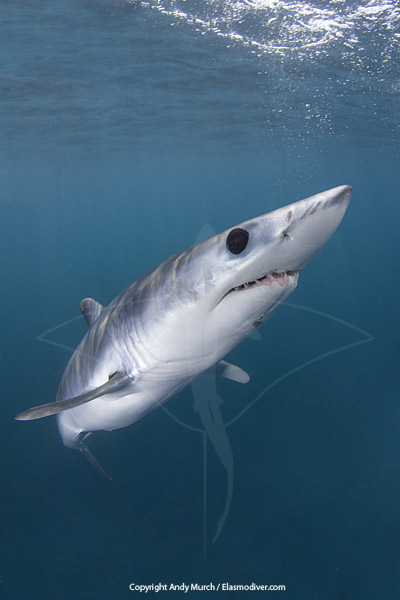
After four days diving the cove our buddy Walter Heim (who I have dubbed ‘the shark whisperer’ because of the subtle way he attracts sharks to his boat) took us out to look for blues and makos. We already had some nice blue shark pics from the beginning of the tour so we were keen to top off our earlier succes with some shortfin mako shots. We spent two calm and sunny days with Walter drifting off the coast of La Jolla. In all, we attracted 3 blues and 2 makos. Not that many sharks compared to the glory days when scores of blue sharks would drive divers from the water but its not always about quantity.

Judging by his scars, one of the blues was a major scrapper. The others were sleek but timid and left even before I had entered the water.
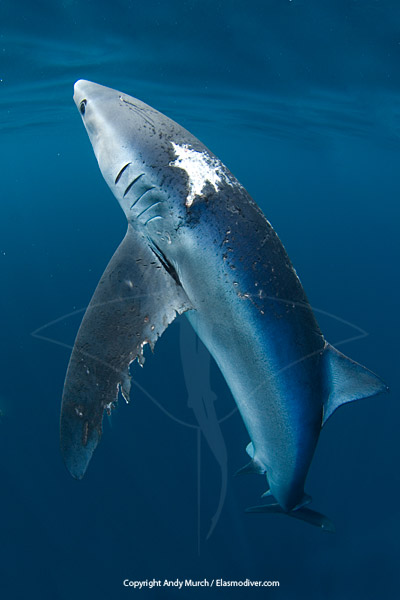
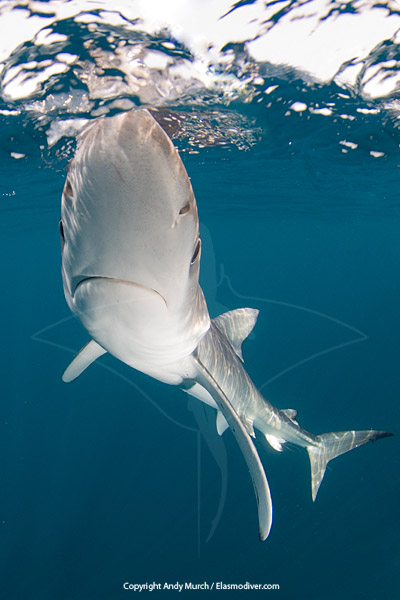
One of the makos was also rather shy but the other was a serious player. It was the type of shark that makes up for every frustrating, half glimpsed, painfully short encounter that you’ve ever had while shark diving.

Initially he was quite shy but once he got used to us he came in close – VERY close. This little mako couldn’t get enough of my camera. I patiently bobbed around on the surface each time he disappeared wondering if he would return. After a minute or two he would show back up and I’d toss him one of the scraps that Walter had supplied me with. Then we’d both race at the bait and the mako would snatch it up and then turn and try to bite my dome port. The images below tell the tale. There are some even closer ones that I’ll share with you after they get published.

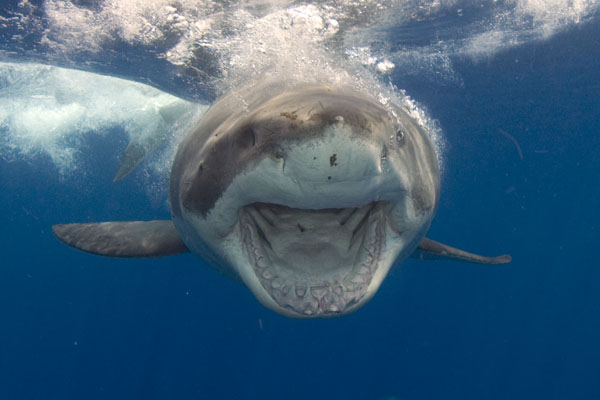
After shortfin makos with Walter it was time to go after the big guys with Lawrence Groth. Lawrence pioneered the white shark cage dives at Guadalupe Island and his Shark Diving International trips are probably the best in the world if you want to encounter white sharks. We met up with 13 other like minded shark fans and traveled together down to Ensenada where we boarded the Solmar V.
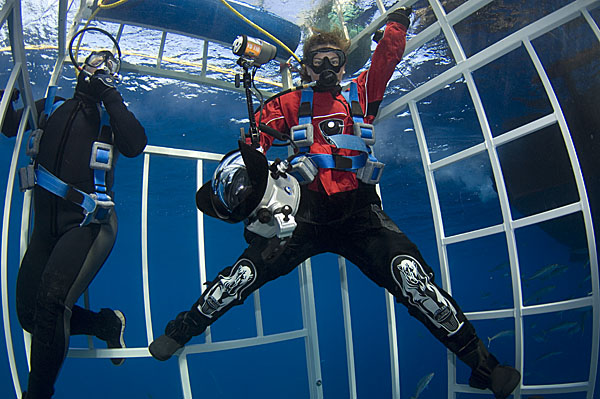
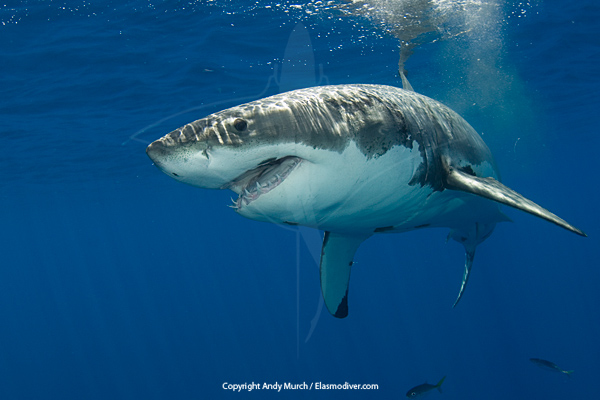
Guadalupe never disappoints. On this trip the sharks started lunging for the hang baits even before the crew had lowered the cages into the water. There were a few slow periods when the sharks disappeared to investigate other boats but over all the action was intense. On the third and final day, Lawrence’s favorite white shark named Zapata showed up. Zapata is a serious showman. Some white sharks (regardless of their size) are surprisingly timid but Zapata is as bold as his namesake. He repeatedly plowed through the water right next to us demonstrating that he could care less about the bubble blowing monkeys in the little cages. Not surprisingly all of my best images are of him.
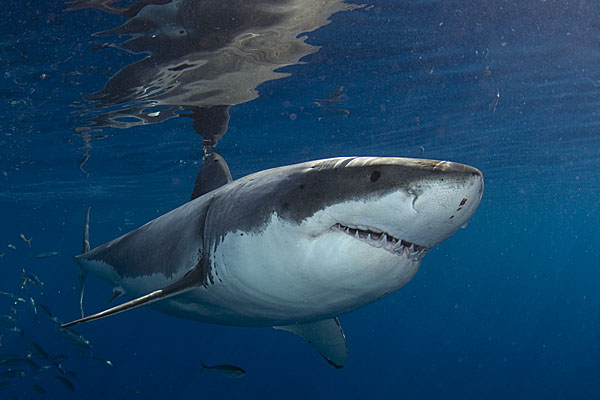
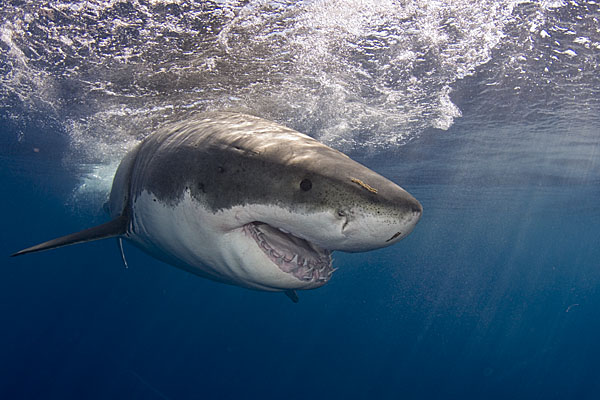
In the evenings we had plenty of time to talk sharks among ourselves and enough time to schmooze with some old friends that we found working at the island. White shark researcher Mauricio Hoyos was there for a three month stint conducting his acoustic tagging study. Each year Mauricio lives in an old shack on Prison Beach near where the shark diving boats anchor. He leads a very primitive existence while in the field but he loves what he does and is totally committed to continuing his research into the movements of the sharks around the island.

Nat Geo shooter ABC (Andy Brandy Casagrande) and the crew of the piratical looking Captain Jack were also moored nearby shooting some out of the cage white shark action.
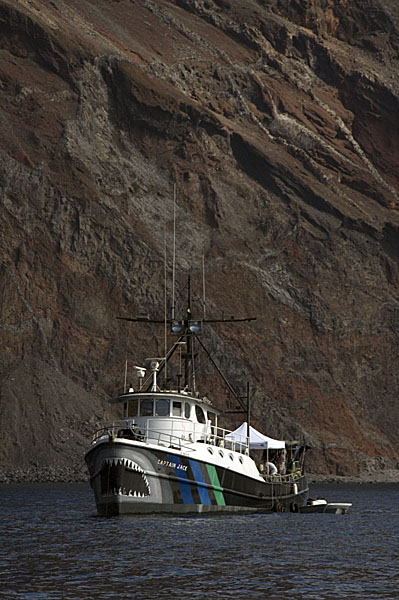
Last December I spent a memorable two weeks working with them in the very same spot so it was great to have a chance to catch up. Andy has an endless supply of shark and other big animal stories and he brought over a copy of his ‘Great White Shark Song’ which features him playing the guitar underwater while swimming next to a white shark. It sounds hokey when put like that but it has a strong conservation message and is well worth watching:

http://www.abc4explore.com/greatwhitesharksong.html

As the cages were loaded back onto the boat I sat and thought about our North American Shark Diving Tour. In the last four months we have driven full circle around most of the continent. We have encountered 33 species of sharks and rays (not including our dip in the Georgia Aquarium). We have collected an impressive variety of elasmobranch images including flying mobula rays, mating round stingrays, enormous whale sharks, tiny deep sea catsharks and two species of sharks that have never been photographed in the wild before.

We have met and worked with hundreds of people including divers, researchers and fishermen and seen sharks in all their splendour and witnessed their plight first hand. We have learned a lot and have been able to tell everyone that would listen about the problems of over fishing and the fragile state of North America’s shark populations. It has been an amazing adventure.

Officially, the North American Shark Tour is now over. But, in the greater context, the shark tour started long before we set out from southern Baja and it will never really end. The quest for images of rare and endangered sharks and rays has defined my role on this planet for the better part of a decade and if I can sell enough images to keep us solvent I expect that we will continue to chase illusive sharks for many years to come.

Right now we are on Catalina Island hunting for Pacific torpedo rays and working out a game plan for the next few months. Pretty soon we will head north to the beaches near Santa Barbara to take another look for swell sharks and angels. Then we’re driving up to Monterey, Elkhorn Slough and San Fransisco Bay to see if we can photograph grey and brown smoothhounds.

By September we will be up in Canada working on cataloging our images from the tour (a daunting task) and rebuilding Elasmodiver with a completely new feel (an even more daunting task). Here is a sneak peek at our new logo:
While we’re ’stuck’ on beautiful Vancouver Island we will make a concerted effort to document the few species of elasmobranchs that we’ve missed in the past. That means a lot of swimming around in muddy bays hunting for deep water skates which doesn’t sound that glamorous but to me it can be just as rewarding as finning along with 40ft whale shark so life will not be so bad.

We also have a lot of other things bubbling including a number of book projects, a few photography courses, some local shark campaigning and of course the planning of our next expedition – the continuation of the shark tour.

After so much time in the water I have a bunch of new species to add to the elasmodiver field guide and hundreds of new images to upload to the shark picture database so please keep an eye on the elasmodiver home page to see whats new.

Thank you to everyone who contributed their time, services, gear, boats, expertise and local knowledge to help us find the species we were after. Thank you also to everyone that emailed us with words of support and encouraged us to keep going through break downs and foul weather. We couldn’t have done it without you. As my dad (who passed away during the tour) liked to say “No man is an island”.

For the sharks,

Andy Murch

The Shark Tour Blogs: Life and Death in Mulege

Life and Death in the Sea of Cortez

April 17, 2009 by sharkdiver

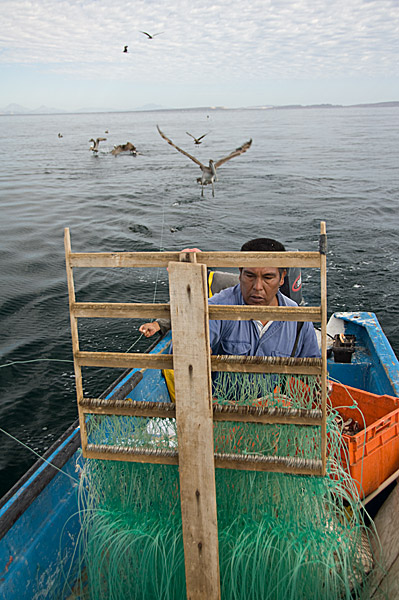
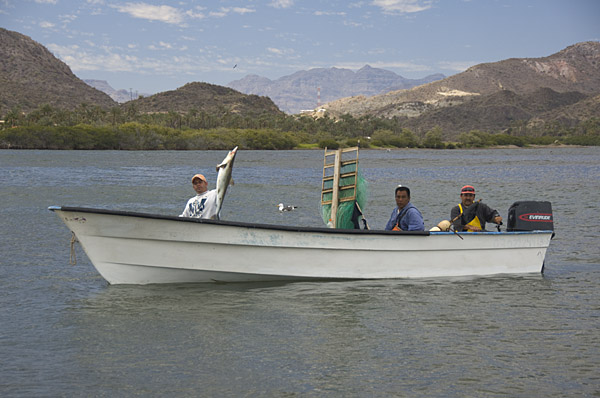
After striking out with the fishermen in La Paz we headed north. For the past few days we have been camping on the beach near the dusty little town of Mulege about a third of the way up Baja’s east coast. Initially we thought that this would be a place that we could shoot all the species of round stingrays that are common in this region but after chatting in my terrible Spanish to the longline fishermen that work the bay I managed to convince one Captain (Martén) to let me accompany him and his crew on one of their longlining trips.

The boats mostly bring in tiny Pacific sharpnose sharks and (over the winter) juvenile smooth and scalloped hammerheads. When I told the fishermen that I wanted to jump in the water with the sharks they thought that I was a little crazy but they were ok with it as long as I didn’t get in the way.

We set out early in the morning but it took a long time for them to get any sharks. In total they put out four kilometers of longlines containing 1400 hooks baited with chunks of yellow striped fish that looked like some kind of grunts. For their effort, the fishermen landed 7 sharks weighing a total of around 20kg. I asked José, the other fisherman who has been in the industry a long time, what it was like in the old days. He told me that 20 years ago on his best days he could land over 1700kg of sharks.

Rows of shark hooks ready to be baited

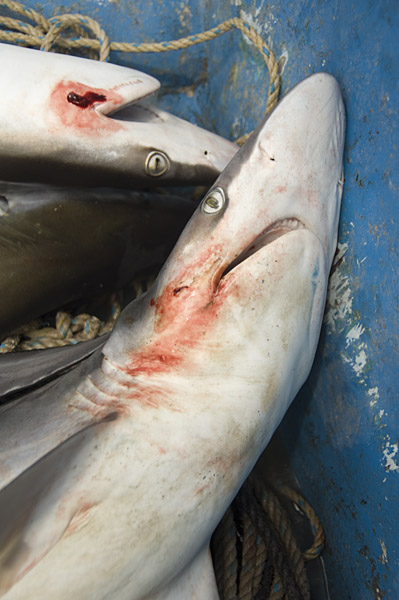
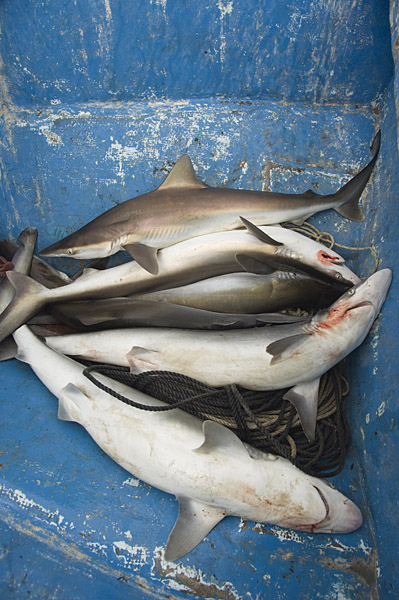
I spent my time swimming around the panga shooting the sharks as they came up the line. It was a depressing thing to document. The sharks were still alive but beyond recovery by the time they were tossed into the bottom of the boat.

I took some shots of the carcasses and then sat there wondering if I was really cut out for this kind of thing. I believe that getting images of long liners doing their work is important from a conservationists perspective but to sit idly by while sharks are left suffocating in the bilge of a panga is a tough gig.

80cm long Pacific sharpnose sharks piled in the bottom of the panga

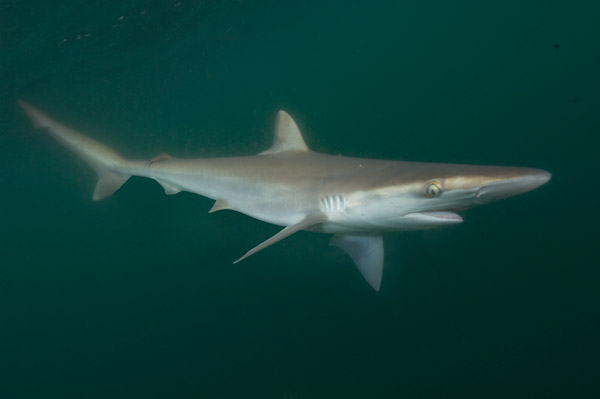
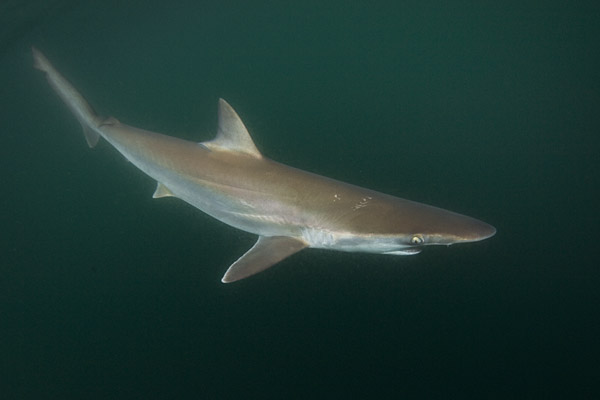
While I sat there, José pulled up a very lively sub-adult sharpnose shark and tossed it at the others. It immediately started flapping around so I figured this one still had a chance. I asked Marten what he thought this shark weighed and he said around 1.5kg. They had already told me that they get just over a dollar per kilo from the traders that periodically show up to buy the sharks so I explained as best I could that I would like to buy this particular shark. They got the idea and from the bemused look on their faces they obviously thought that I was completely loco but they agreed to sell me the shark and I grabbed it gently in front of its tail and dropped it back in the water before it could beat itself senseless on the deck planking. Two bucks for the life of a shark! What would it cost to keep these fishermen home for good?

Possibly these are the first images of a free swimming Pacific sharpnose shark

I know that I didn’t really achieve anything by liberating one little Pacific sharpnose shark but maybe my token act had some effect even if it was a small one. After I released the shark we talked as best we could in broken Spanish about the problems that sharks are facing and their important place in the ecosystem. They already understood the big picture maybe even better than me. I asked them what they would do if they couldn’t fish for sharks and they shrugged and said that they would fish for something else. Doing anything other than fishing seemed to be a bizarre concept that they did not want to entertain. If any real change is to take place it will have to come from the next generation.

Marten’s son in Law Aaron proudly holds up a sharpnose shark

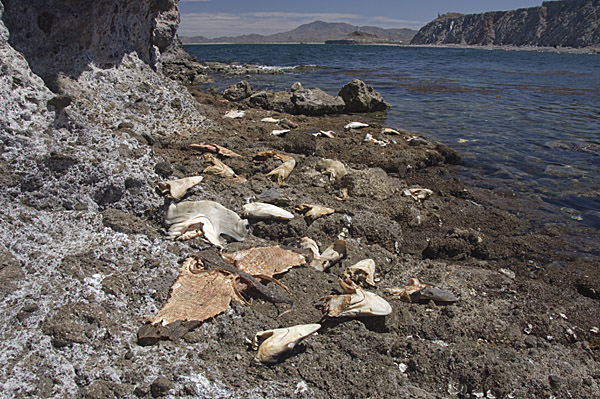
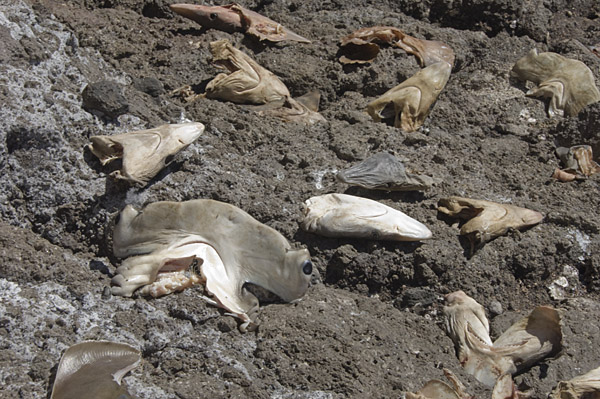
After bidding farewell to the fishermen Claire and I went for a long hike along the rocky shore north of Mulege. Just before sunset we spotted some birds in the distance and went to investigate. What we found was a shoreline littered with discarded shark and ray heads. It was a tragic site. They were mostly Pacific sharpnose sharks and small smooth hammerheads but there were also a number of guitarfishes and the carcass of a butterfly ray. All in all it was a grim day.

Discarded shark heads littering the shoreline north of Mulege

The next day we returned with our cameras to photograph the grizzly remains and then spent the afternoon chasing round stingrays in the shallows next to our campsite.

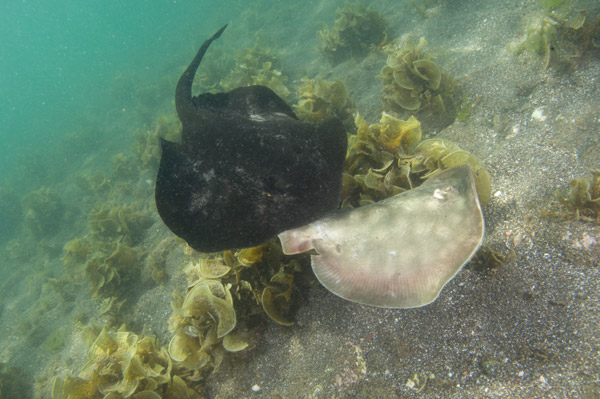
In 5ft of water the stingrays were everywhere. It was a refreshing change to see so much life after so much death. We must have seen two or three hundred rays. Mostly round stingrays and a few Cortez stingrays.

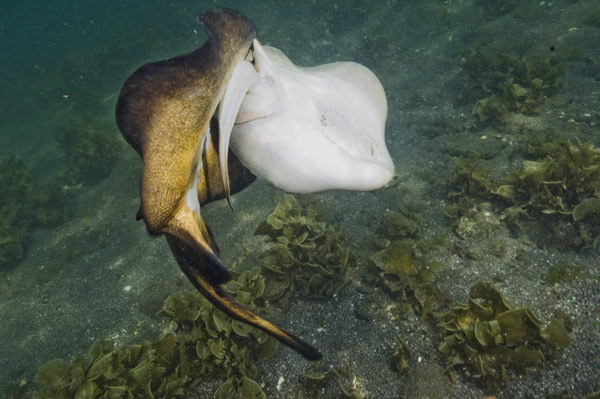
The rays were very skittish and exploded out of the sand and darted away as we approached their hiding places but one older male round stingray let me get really close. I followed him around for a good half an hour and just as I was planning to head for shore he ducked down and latched onto a female ray that was sleeping under the sand. For the next 5 minutes I was able to watch an amazing spectacle as the male ray struggled to subdue his mate. The female put up a valiant fight as they spiraled around and around each other oblivious to the flashes emitting from my camera system.

That night I slept a lot better. The balance of species may be shifting but at least there is still life in the Sea of Cortez.

Stingray porn – a male Round stingray (Urobatis halleri) latches onto the tail of a female before mating

We were planning to look for Mexican Bullhead Sharks further north in Baja but it appears that they are so rare that no one I have spoken to has ever seen one. So we have decided to spend a couple of days slowly driving north and then cross the border into Southern California. San Diego here we come.

For the sharks,

Andy Murch
Shark Pictures

The Shark Tour Blogs: Leaving La Paz

Leaving La Paz

April 7, 2009 by sharkdiver

For the last few days we’ve been based in La Paz trying to hook up with the artesanal shark fishermen that ply the waters on the north side of the bay. Last time we were here I managed to get some good shots of smooth hammerhead sharks but this time the fishermen are even more illusive than the sharks and we have had a great deal of difficulty tracking them down. I was hoping that we could document them while they fish for Pacific sharpnose sharks. This is their main target species that lives year round in La Paz bay and elsewhere along the coast. It is a fairly abundant little shark but it still needs to be carefully monitored to make sure that the sharpnose stocks do not fall to critical levels.

The fishermen average about 5 sharks per trip at this time of year but they take considerably more in winter. The sharks are too small (max one meter) for the Asian fin market but the locals relish the meat and the sharks fetch around 60 pesos (4US$) per kilo at the fish market. That makes their trips worthwhile even if there are not that many sharks around.

We’re planning to try one more time tomorrow to catch them at their fishing camp and then give up and move north.

The Easter holidays (Semana Santa) ramp up over the next few days. Easter is a massive event in Mexico and in Baja anyone with a tent heads to the beach. That means that the beaches around the main population centers down near La Paz will be zoos for the next few days. We want to get as far north as possible in the hopes that we’ll miss the flood of Mexican holiday makers but the chances are that wherever we end up we’ll probably still be swept up in the festivities. That’s ok; ‘when in Rome’ and all that.

I haven’t been in the water much since our last blog but I’ve still been talking sharks. A few days ago we met up with Documentary Maker Mike Hoover at the La Paz opera of all places. I haven’t seen Mike since our last trip to Guadalupe Island. Mike is a fascinating guy. His career in the film industry has been colorful, exciting and tragic in equal measures but his resilience and no nonsense astute personality are what I like about him the most. He is best known for his frontline work in Afghanistan during the Russian invasion and his cutting edge mountaineering films (among others) that have been well received by audiences around the world for decades. He has also worked on blockbusters like Forest Gump, Crimson Tide and The River Wild. More recently, he has been involved with numerous films about Great white sharks aboard his expedition ship the Captain Jack which is how I met Mike for the first time last year.

This time we only managed a short conversation before the singing started so I hope that I get another chance to talk and work with him soon.

Our next stop will be a day’s drive north on one of the white sand beaches around Bahia Conception. There are many beaches that we have never had the time to visit and some that are old favorites. All of them are home to hundreds of tiny Round and Cortez stingrays so we’ll be strapping on the snorkels once again and chasing rays until the sun goes down.

We wanted to keep this tour as fluid as possible but everyone we plan to visit has schedules so we’re slowly having to nail down dates for each adventure. The good news is that we have had a great response from all our friends and some once in a lifetime offers to do some very exciting diving. It now looks like we may be able to take a crack at sevengills in the wild with our shark tagging buddy Walter Heim. And, when we finally get to the Mississippi Delta we have an invitation to join a field trip with Dr Eric Hoffmayer from the Gulf Coast Research Laboratory. The GCRL is conducting an abundance and distribution study on coastal sharks and rays so that means that we will get to photograph lots of hard to find species like finetooth, Atlantic sharpnose, juvenile bulls and who knows what other sharks, not to mention all the illusive ray species that inhabit that part of the coast – I’ll be in elasmogeek heaven.

You can now follow our schedule at the following link:

http://www.elasmodiver.com/northamericansharkdivingtour.htm#Itinerary

For the sharks

Andy Murch

Shark Pictures

The Shark Tour Blogs: Pre-tour life in Baja

An unexpected find in the Sea of Cortez

February 14, 2009

A few days ago I went out snorkeling with my friend Mauricio Hoyos. He is a shark researcher based in La Paz. He has a number of projects on the go including a distribution study on Great White Sharks at Guadalupe Island. From September through December each year he camps on the remote island west of Ensenada to track white shark movements and document predations from his little panga. It is a lonely and sometimes unrewarding project but he is fanatically dedicated to the task.

When he is back in La Paz he spends his time writing proposals for funding and finding creative ways to finance his work. He is also studying the movements of Scalloped hammerheads in the shallow bays north of La Paz. Mauricio thinks that the area is a nursery ground for this species and the sharks probably stay there for a long time before moving out to a more pelagic environment. If he is right then his work may lead to stricter regulations for the fishermen that long line along the coast.

To track the baby hammerheads Mauricio goes out with the long liners. If they bring up a live scalloped hammerhead shark he implants an archival tag into the torso of the animal and releases it. The tag records temperature and depth information which can be analyzed later (if the animal is caught again) to estimate the sharks movements.

Mauricio invited me to join him on one of these trips and we spent the day north of La Paz with a couple of local shark fishermen. It was tough to watch them work. They did not have much success but all of the little sharks (none were longer than one meter) that they did bring up were already dead. Some shark lovers may have reservations about a shark photographer and outspoken conservationist working among shark fishermen but I believe that I did not contribute to or encourage the deaths of any sharks and the understanding that I gained about the shark fishing industry will stand me in good stead for future arguments. In the words of the warrior philosopher Lao Tzu “Know your enemy”.

We waited on the panga while they slowly pulled in their lines. They brought up a couple of tiny Pacific sharpnose sharks and then the line began to jerk and spin. The fisherman pulling it in indicated that something big was coming up so I slipped into the water with my camera and stared down at green nothing. The Sea of Cortez is heavily laced with plankton and visibility rarely opens up. A pinkish blur solidified below me and swam in agitated spirals around the line.

Mauricio had told me that the long liners sometimes catch rayas violaceas but I had never heard of Violet Rays and nothing fitting that description was in any of my local fish i.d. guides. Once the ray was close enough to see it clearly I recognized it as a Pelagic stingray Pteroplatytrygon violacea.

It is a unique animal among stingrays because unlike other whiptail stingays it swims in open water instead of hiding under the sand.

It is rarely if ever encountered by divers. I have never seen one and thought that I never would so I was thrilled to get the chance to see it in action but wondered what the fishermen would do with it. I assumed that they would add it to the catch which was piling up in the bottom of the panga but they carefully pulled it along side and removed the hook without causing it too much damage. The ray turned and flapped quite slowly back into the green. I gave chase for a few kicks and then let it go.

The unexpected care with which the fishermen released the ray was quite surprising and it made me think a little harder about who they are. Their job is certainly destructive to the environment and devastating to the future of sharks but I believe that they mostly do not fully comprehend or believe this. They are proud fishermen that have chosen to fish for sharks and consider themselves no different from other hard working fishermen. As we watched them set their lines they told us about some of the strange creatures that they have encountered over the years like the 5 meter long oarfish that swam by one day. It is clear that at least some of them are just as fascinated by the wonders of the ocean as I am but they choose to exploit its resources where as I believe that the ocean has given up too much of its wealth already.

Change does not always come from forced legislation or a big stick. Sometimes the most productive change comes from subtle discussions intended not to offend but to educate. So, I will go out with these fishermen again if Mauricio invites me and perhaps in time we will have a chance to discuss why their shark catches are dwindling and what they can do to help shark stocks recover.

For the sharks,

Andy Murch