About Me

My photo
I am a Shark and Big Animal Photographer and the Founder of Big Fish Expeditions. I also pilot research submersibles on rare occasions but primarily I photograph sharks and rays. The shark images that I take have been used in many commercial publications but most importantly I try to concentrate on shooting rare and endangered species of sharks for conservation initiatives. It is a labour of love.
Showing posts with label Scuba. Show all posts

Tuesday, April 13, 2010

An Incoming Tide of Adventure

Like a stingray stranded on a mud flat, I have been stuck on land for way too long. I spent the winter working in other fields to raise a shooting budget for 2010 and with that taken care of, its time to embark on a six week expedition through New England, Florida, The Bahamas and Honduras. The plan as always, is to shoot as many new species of sharks and rays as possible.

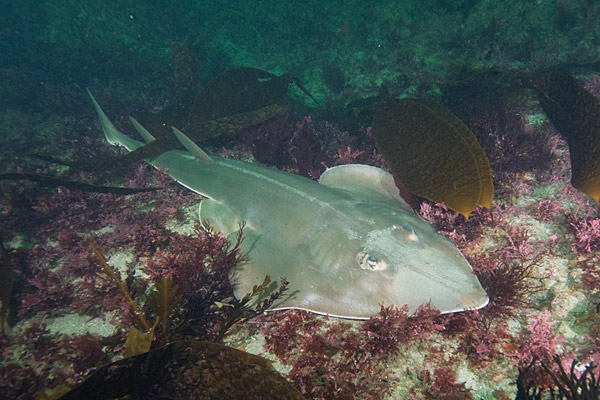
Right now I am in Rhode Island. Home to makos, blues, threshers, the occasional white shark and lots of deep sea skates. For those that don't know, skates are a type of ray and are therefore closely related to sharks. One big difference between skates and other rays is that skates lay eggs. They are also very specious. If fact, they are the largest of all shark or ray families and because most live in very deep inaccessible areas, scientists are still finding new species on a fairly regular basis.

I am particularly interested in shooting barndoor skates which Greenpeace International recently added to its Seafood Red List. Greenpeace's red list is a list of fish that are commonly sold in supermarkets around the world, and which have a very high risk of being sourced from unsustainable fisheries. On the other hand, NOAA recently downgraded the barndoor on its 'species of concern' scale but the continuing directed fishery and high by-catch levels make it an ever-vulnerable species.

You can't dive with deep sea skates in their natural environment unless you happen to own a research submersible. Sadly, a sub is out of my budget this year but I have a buddy named Brian Raymond who works on a fishing trawler that often plies the waters of The Georges Bank where barndoor and other skate species are fairly common.

You may think that its odd for a conservation minded shark photographer to be hanging out with a fisherman but Brian is no ordinary fisher. After 5 years in the industry he is very tired of being part of the problem. This summer he is quitting his job and going into business with Shark Film Maker Joe Romeiro. They will be running eco-friendly blue and mako viewing trips out of Rhode Island so if you're up this way and want to get in the water with some beefy New England sharks, give them a call: 333 Blue and Mako Shark Expeditions

The boat that Brian works on mostly trawls for squid but trawling is an indiscriminant form of fishing so the by-catch levels are often horrendous. Recently, they have been dragging in 1000ft where there are a number of vulnerable skate species so we worked out a plan to try a catch and release photo shoot with some of the skates that he rescued from the nets. It should have been a simple way to nail some shots of never before photographed species but the best laid plans can go awry.

While Brian was returning from his last fishing trip, I flew in, stashed my stuff at Joe's place and got ready to start shooting. Brian and his girlfriend Jen met me at a local beach and Brian pulled a tote of slowly flapping skates out of the back of his truck. When I found that he had managed to bring not one but three deep sea skate species I was as happy as a kid at Christmas.

The plan was for me to swim out to clear water and release the animals on the sand and rocks where I could get some usable ID shots before they swam away. I was petrified that they would bolt before I could get any images but that turned out to be the least of my problems.

R.I. is recovering from the worst flood in 200 years which has thrown millions of gallons of dirty water into inshore coves like the one we were shooting in. To make matters worse, the day we chose to release the animals, the weather was far from ideal. Strong winds, lashing rain and turbulent seas made the whole swim out from shore rather daunting. I went out for a test run just with my camera and found the going pretty tough. It didn't help that I was nursing a fever and a throat infection and apparently my drysuit had somehow gained a lot of extra buoyancy over the winter :) leaving me considerably underweighted.

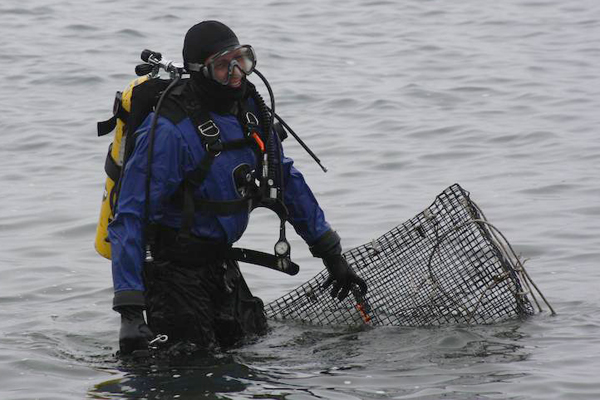
Unperturbed, I kicked back to shore, found some scrap iron on the beach and strapped it to my tank. Then, I filled my pockets with rocks and ventured out again, this time with my camera in one hand and a lobster trap full of deep sea skates in the other.

Clutching such a voluminous object in rough seas put me in an unexpected position. I found myself at the mercy of the rip which dragged me out of the bay into an area that was churning like a washing machine. Looking down, the visibility was so bad that I couldn't see my camera dangling at my side, let alone photograph marine life. I tried retreating but I could barely make any headway back to the beach and I was slowly drifting sideways onto a patch of submerged rocks that was throwing extra large waves in my direction.
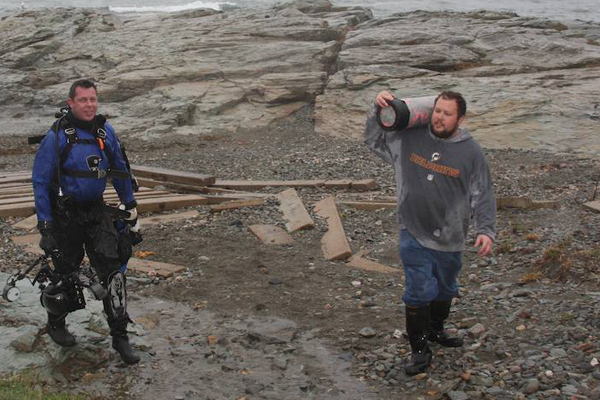
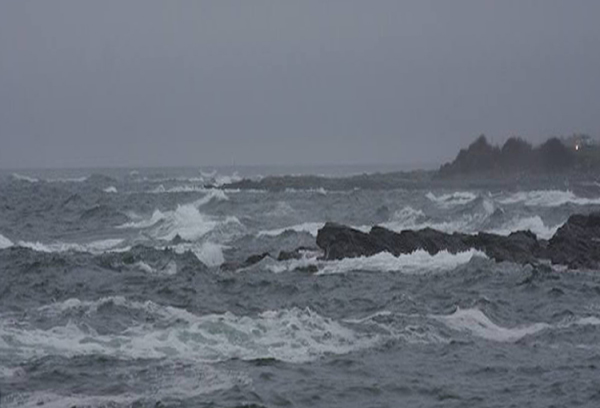
I tried sinking under the buffeting chop but my drysuit inflator jammed open, lifting me back to the surface and filling my suit to Michelin Man proportions. I had no choice other than to disconnect the air hose but as the air trickled out, the sea trickled in and within a minute or two my suit was completed flooded.

Now I was starting to feel a bit uncomfortable. I'm not one to panic but I was riding so low in the water that I couldn't tell which way the shore was. While I was deciding whether I should drop the lobster trap (making the entire trip to New England a disaster) I spotted Brian waving from the rocks with a pair of binoculars around his neck. With new resolve I inched towards shore. Cage in the left hand. Camera in the right. KICK! Look up. reorient to shore. Head down. KICK!

It was slow going but I made it back into the shallows and dropped the cage in a sheltered spot to rest. There was no way I was heading out to sea again so I gently lifted a skate out of its confinement and let it go. The skate swam around a little and then settled onto the sand, cupping its body to provide the suction necessary to resist the surge that was still pulling me around.

By working with a fisheye lens within about six inches of each skate, I was able to get some images that looked like they were shot in much clearer water than they really were. After maybe an hour I dragged my wet and weary bones out of the bay and left the skates to find their way out to sea.

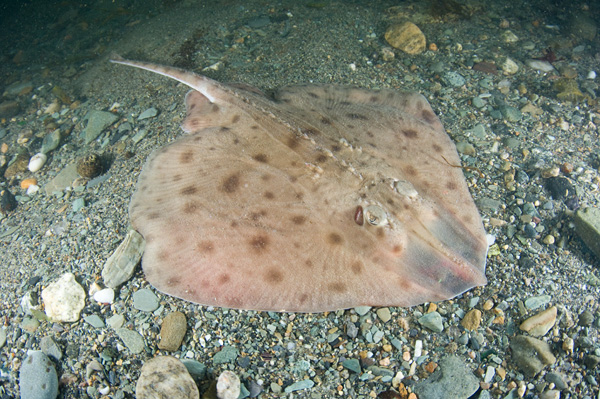
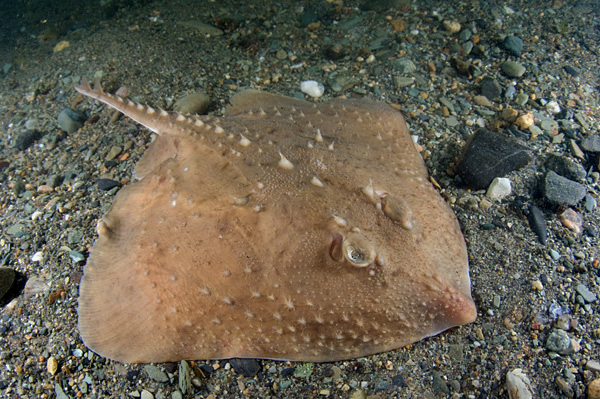
Barndoor, Smooth and Thorny Skates
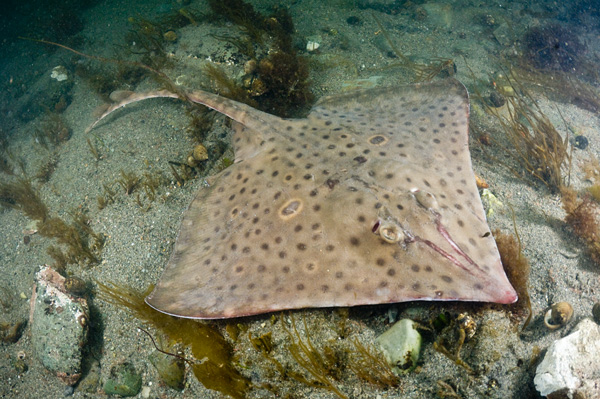
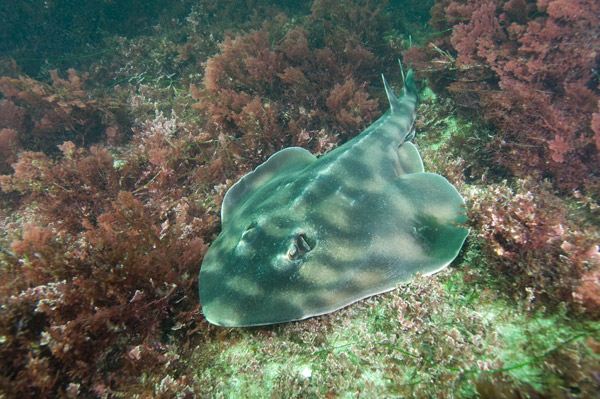
That was two days ago and I'm still feeling whipped but the images came out great. Three more species for the Elasmodiver Shark and Ray Field Guide. Three more elasmos available for any conservation initiatives that might need images.

Next stop Washington State for a couple of days diving on the Olympic Peninsula with Claire and then I fly down to Florida to lead a week long Photography shoot at Tiger Beach in The Bahamas. After that, the trip starts to get interesting!

Sharkfest 2010

In other news, Sharkfest is getting exciting. As a new facet of the Predators in Peril Project we are starting a simple new campaign inspired by a constant flow of emails from people that want to do something to help sharks in their local communities. Its called the Shark Friendly Restaurant Initiative. The idea is for individuals to use fact sheets and decals that we will supply to approach restaurant owners in their communities that sell shark products (not just shark fin soup). If a restaurant agrees to become part of the solution, they get a Shark Friendly Restaurant Decal for their door and a listing in the Shark Friendly Restaurant Guide on Elasmodiver. Where possible, we will arrange for the campaign to be listed in local food and entertainment magazines so that conscientious consumers can learn what the decal looks like and patronize the right restaurants. Seafood Restaurants that already refuse to sell shark products get a decal right off the bat which will help to brand the idea.

What does this have to do with shark diving in North Carolina? Well, the campaign is being sponsored by the profits from Sharkfest. If I manage to fill the boat, we'll have a budget to print enough decals to get started. You can find out more about the campaign at this link: Shark Friendly Restaurants.

On a more fun note, we also have our first shark film submissions. The first to arrive was Big Fish Utila an excellent film about whale sharks in the Bay Islands. We'd like to have at least a dozen short films to view over the weekend so if you know anyone that has made a shark film recently or if you have a film of your own to submit, please tell us about it. Film submission is free.

There has been a lot of interest in the trip but there is still room so if you would like to come diving with Sandtiger Sharks with us and a bunch of other shark fanatics for 3 days in early August please let me know. Sharkfest is $640 which includes 3 days shark diving, accommodation, a Sharkfest 2010 T-shirt and our 'shark friendly' Barbeque.

One shark diver suggested that we include a sandtiger night dive in the agenda. That sounds like fun to me but I'd like to hear what you think!

TB2

The Tiger Beach Photography Workshop appears to be a very popular concept. I've never seen a trip fill up quite so fast. So... I'm considering running a second workshop/expedition in the fall. Email me if you're interested.

Lastly, Elasmodiver is getting out of control

Some people have commented that Elasmodiver is getting too big to navigate. No argument from me! So how do you get your head around a website with almost 500 pages? Its a puzzle but at least its easy to keep track of recent changes by bookmarking this link: Elasmodiver Updates. Its the simplest way to scan what is new, what has changed and when. And, if you have suggestions on how Elasmodiver could be made better, pleeeease let me know. Elasmodiver remains one of the largest sources of shark info on the internet. Help us keep it user friendly.

For the sharks,

Andy Murch

Sunday, December 20, 2009

Shark Pictures, Shark Projects and maybe a Shark Photography Workshop

Shark Pictures, Shark Projects and maybe a Shark Photography Workshop

November 30, 2009 by sharkdiver

The 2010 Central American Predators in Peril Expedition is taking shape. This will be the most exciting project that Elasmodiver has ever been involved in. If you thought that the 2009 North American Shark Diving Tour was ambitious, please have a quick look at the itinerary for the 2010 expedition. Its all laid out on the new Predators In Peril page on Elasmodiver.com
To quickly outline the mission: Beginning in early May, we will be traveling through nine countries along the entire length of Central America to photograph new species of sharks. We have arranged to work with local researchers in many locations and we will also be working with artisanal shark fishermen and with a number of Central American dive operators.
We are hoping to photograph at least a dozen new species that have not yet been documented in the wild. The images will be used in an extensive public awareness campaign and then offered to regional conservation groups to promote local conservation initiatives.
We have put in a couple of funding proposals but we still need help with equipment and field expenses. Please take a look at the Predators in Peril Expedition Wish List if you think you may be able to help. And, please spread the word about the expedition through any networks that you are involved with. Media coverage is a very important part of the project.

TIGER BEACH
In other news, I have just returned from Tiger Beach in the Bahamas. It was an unexpected last minute shoot that I almost didn’t go on but I’m glad I did because the sharks were VERY friendly on this visit and the shooting opportunities were outstanding. If you’ve never been to Tiger Beach you’d be forgiven for imagining a palm fringed island surrounded by big striped sharks but TB isn’t actually a beach at all. It’s a sand bank in the middle of nowhere that rises to within about 20ft of the surface. The lemon sharks that patrol the area have become accustomed to the occasional dive boat passing through and the sound of an anchor chain rattling down to the seabed acts like an aquatic dinner bell.
For first time visitors it can be very daunting seeing a score of large lemon sharks circling just below the swim step but lemons tend to be pretty well behaved sharks. Tigers (in my opinion) are a little more unpredictable. The tigers usually show up in ones and twos but you never really know what Tiger Beach will dish out. I’ve heard of divers encountering a dozen tigers on a single dive. I’m sure that would be fun for the adrenalin junkies that go shark diving for kicks but it would make my job a little tricky so I’m glad that we only saw a handful of tigers over the course of the week.
I need an accommodating shark that is bold enough to come in close and pose but doesn’t get out of control and swim off with the bait box. The 4 meter female that adopted us on this trip was almost the perfect shark. ‘Fluffy’ as we called her, was a beautiful animal that moved slowly among us for the better part of two days. Judging by her distended belly she was either digesting a turtle or almost ready to give birth to the next generation of baby tigers.
Between Fluffy and the omnipresent lemon sharks it turned into a great shoot:
http://elasmodiver.com/Tiger%20Shark%20Pictures.htm

MORE IMAGES ON ELASMODIVER
After Tiger Beach I had a week to kill in Florida which would normally have involved lots of snorkeling with stingrays and hunting for little coastal sharks but I’m ashamed to say that I barely got wet even though I was holed up right next the beach in Fort Lauderdale. I spent the week sitting in a darkened hotel room cleaning and sorting all of the images that I have taken this year. It was a mammoth undertaking but I’m finally caught up (almost). Pretty soon there will be a whole lot of new images on Elasmodiver.com – I promise!
Here are some new leopard shark pics to keep everyone happy:
http://elasmodiver.com/Leopard%20Shark%20Pictures.htm

2010 SHARK SHOOT IN THE BAHAMAS
While in Florida I attended DEMA – the yearly North American Dive Industry Bash. I’m glad I went because after 4 days of schmoozing with magazine editors and dive operators I walked away with lots of exciting plans for next year. So many plans in fact that there is no way I can work on them all, but even if I make half of them happen it is going to be an amazing 2010.
One tentative plan I have is a Shark Photography Workshop in the Bahamas. This is a new direction for me. Other professional shooters have done similar workshops but I have been biding my time until I was sure I had something worth offering.
Now I’m ready. We’re looking at a 3 or 4 day shoot, mostly working with Caribbean reef sharks in different environments. Two dives a day plus ‘how to’ workshops, photography critiques (don’t be shy) and daily slide shows.
The idea is that you walk away with some good pics, a better understanding of how to shoot sharks and some great stories about the crazy time you had with a slough of other shark shooters in the Bahamas. Space will be limited so if that sounds like fun let me know! Depending on interest, I’m hoping to set some dates in April before the Predators in Peril Expedition gets underway.

NEW ELASMO T-SHIRTS!
Another spin off from DEMA, I bumped into Tom Sergent who operates the company Amphibious Warrior Scuba Wear which raises money for shark education and conservation activities. Tom is a big supporter of Elasmodiver and he has agreed to produce our new Elasmo T shirts that have been getting rave reviews. His new AWSW website will soon be up and running but for now, if you want to order an Elasmo T, go to Tom’s AWSW fan page on FaceBook:
Amphibious Warrior Scuba Wear on Facebook
The Elasmo T’s are US$22. All proceeds go towards the Predators in Peril Project:

BAIT BALL DIVING IN THE SEA OF CORTEZ
Tomorrow I leave for Cabo san Lucas in Baja to shoot Marlins with Shark Diver Magazine. “MARLINS?” I hear you say. Well, its a trip to shoot marlins attacking bait balls. Don’t tell the editor but I’m only going incase some sharks show up to feed as well. If they do, I’ll just have to wait for those pesky marlins to get out of the way so that I can get the shot.

For the sharks,
Andy Murch
The Shark Tour Blogs: Back to the Gulf for Guitarfish and stingrays

Back in the Deep South

September 25, 2009 by sharkdiver

Back in the Deep South

25th June 2009

Since our last post Claire and I have been shooting rays down in South Florida again and have once more returned (for the final time!) to the northern gulf. All the back tracking is a bit painful but it gave the garage time to fix up our vw van. Now we have a tour bus that purrs like a kitten and we’re in good shape to start heading north.

While in the sunny south we hooked up with our good friends who run Scuba Works in Jupiter, FL. Jupiter is the sharkiest spot in So Flo for big carcharinid sharks like lemons and bulls but sadly we were not able to entice any of them up from the depths.

The shore diving was fun and I photographed some yellow stingrays for posterity. These are not a new species for me but the last time I shot them I was wielding a Sony Cybershot point and shoot. That was back in the days when shark and ray photography was a hobby with no pressure other than the personal satisfaction of nailing the shot; ah the good old days.

We also went diving with Brendal and Ryan from Prodive USA in Fort Lauderdale. Brendal is a serious shark conservationist and is a campaigner for Shark Savers. So, between dives we sat and discussed tactics in the struggle to save sharks.

Brendal is hoping that Shark Savers will ultimately fall under the umbrella of Shark Safe (the names get confusing) which is a budding alliance of grass roots conservation organizations. The idea is that if all the shark conservation movements can work together they will have significantly more clout. I’m all for it.

The Fort Lauderdale dives were fun and we did see some nurse sharks but after a few days the call of the unusual lured us back to the gulf. Before we left we sat down with Ryan and Brendal for an interview about our tour which can be seen here: http://www.youtube.com/user/ProDiveUSA

First stop back in the Panhandle was Panama City. Each time I come here I see something different. The first year it was all Atlantic stingrays, then it was mobulas and southern stingrays. This time the ocean surprised me again by offering up a pier full of Atlantic guitarfish. I love the diversity of the Gulf of Mexico!

For the Sharks,

Andy Murch

The Shark Tour Blogs: Gulf of Mexico Whale Sharks

Tagging Whale Sharks in the Gulf of Mexico

September 25, 2009 by sharkdiver

Tagging Whale Sharks in the Gulf

14th June 2009

We are aboard the 67ft commercial fishing vessel Norman B which operates out of Leeville, Louisiana. The Captain/owner of the ship – Russell Underwood – has a deep fascination with the ocean that he has been sailing over for the last three decades. Last year he and his crew witnessed some large aggregations of whale sharks in which upwards of 100 animals came together to feed at fish spawning events around the northern gulf. Awe struck by this amazing sight he was inspired to hang up his fishing gear for a week and invite our gang of researchers and film makers on an expedition to record and tag the behemoth sharks.

Over the past seven days we have witnessed around a dozen whale sharks feeding on dense floats of fish eggs which Dr Eric Hoffmayer will eventually identify once he returns to his lab in Ocean Springs, Mississippi.

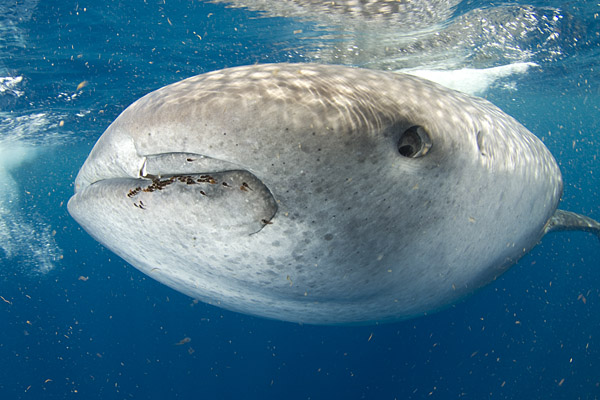
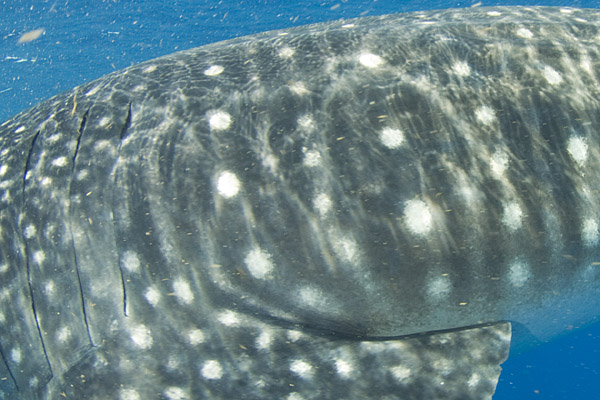
Claire and I were invited aboard to take i.d. shots of the sharks for the Ecocean inititive. This is an international database of individual whale sharks that have been positively identified by recording the unique spot patterns that occur behind the whale sharks left gill openings.

The composition of the markings in this area does not change significantly as the animal grows so it acts like a thumb print that can be entered into a program that utilizes stellar mapping software to match up images taken at different times and places. Potentially, this can be used to track the movements of whale sharks without using expensive (and invasive) acoustic or satellite tags.

We also had three sat tags on board that Eric was able to place on the sharks. In 8 or 9 months time these devices should detach, float to the surface and transmit their data to any satellites that are passing by.

On the third day I managed to crack a rib while pulling myself back into the chase boat. If memory serves that is my 15th broken bone which is a pretty sad testament to my clumsiness or maybe I simply end up in harm’s way more than most people. Either way, it made for some painful days and nights and didn’t help my struggle to keep up with the sharks.

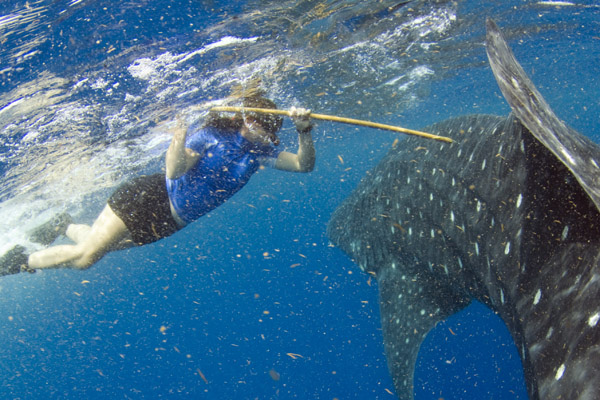
After we deployed all the sat tags we decided to spaghetti tag the other sharks so that we could tell which ones we had already swum with because one enormous spotted shark looks surprisingly like another. I stayed on thumb print photography duty but Claire actually got to tag a 25ft whale shark which she managed to deftly accomplish on the first attempt.

When you’re motoring across it, the gulf is a seemingly endless body of water and although whale sharks are the biggest fish in the sea, searching for them is like looking for the proverbial needle in a haystack. To find them we cruised along one tide line after another but you can only stare at blue water in search of fins for so long before you start to go bug eyed.

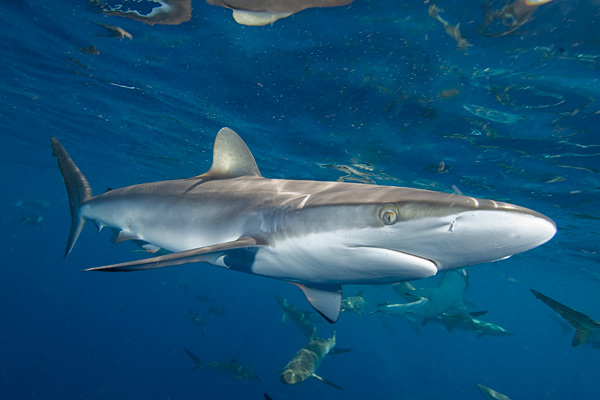
To break up the monotony, every day we tied up to one or two of the 5000 oil rigs that are sprinkled along the continental shelf. We wanted to chum up some predatory sharks that Eric was also interested in tagging. I think we were all surprised that at most of the rigs the sharks were a no show but at one particular spot we finally encountered a nice assortment of silky sharks.

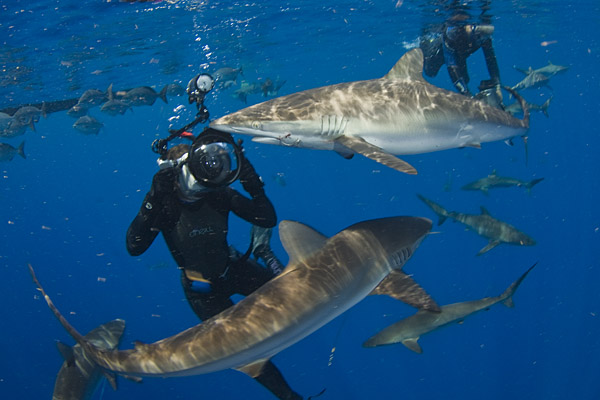
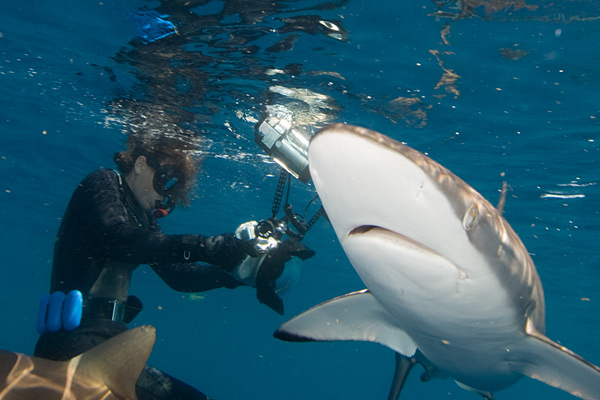
Claire and I immediately jumped in with our cameras which amazed the crew who see these sharks every day but live under the impression that anyone dumb enough to fall overboard would be consumed in an instant. Within a short time they developed a much better understanding of the nature of sharks and by the end of our time in the water they actually wanted to join us but we discouraged this as they didn’t have wetsuits and the brush of a friendly silky shark on bare skin can result in some nasty abrasions.

Claire got some good silky shots and I in turn got some nice pics of her shooting away surrounded by sharks:

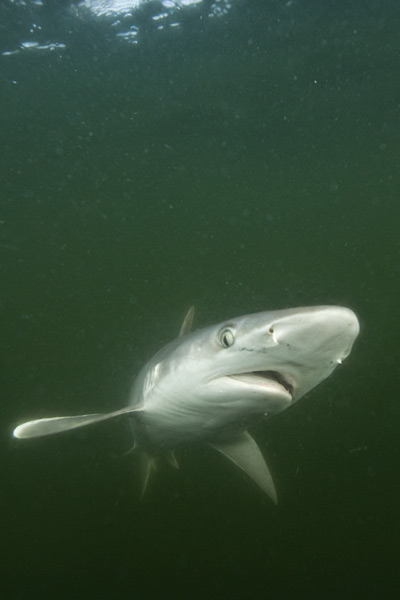
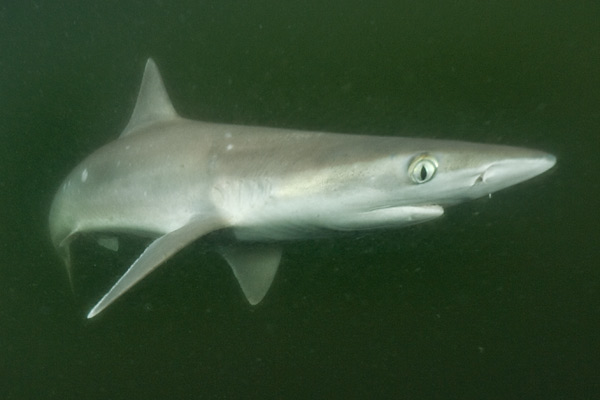
Below the silkies I spotted a new shark for me! Two spinner sharks were cruising below the melee, curious but too timid to approach the chum. Spinners are notoriously shy around divers and swimmers. It is ironic that the shocking aerial shots of enormous schools of sharks swimming past Florida’s busy beaches each summer are mostly pics of migrating spinners which wouldn’t dream of harassing a beach goer.

They were impossible for me to approach but I fired off a few frames from a distance and the resulting i.d. shots are grainy but better than I thought they’d be.

spinner shark

While on the rigs the crew threw in their bottom fishing gear and brought up an interesting assortment of fishes. Some of these ended up in the pot but being ‘veggies’ Claire and I didn’t sample any of them. The highlight for us was a Gulf of Mexico smoothhound shark which we photographed from every angle before releasing it under the rig.

Tomorrow morning it will all be over. Captain Underwood and his crew David, Jack and Ron will go back to fishing for red fish and grouper, Eric and his assistant Jenifer will return to their lab, Film Maker Ulf Marquardt will fly back to Cologne to edit his documentary and Claire and I will drive down to Port Charlotte in southern Florida to pick up our (hopefully fixed up) camper van and head to the keys to chase stingrays and nurse sharks. But, this adventure will live on as one of the highlights of the North American Shark Diving Tour.

For the sharks,

Andy Murch

The Shark Tour Blogs: Gulf of Mexico Silky Sharks and Atlantic Sharpnose Sharks

Gulf of Mexico Sharks

September 25, 2009 by sharkdiver

Gulf Sharks

15th May 2009

The west coast and even Texas is already starting to blur. We are now driving around the Florida Panhandle looking for bluntnose and Atlantic stingrays to photograph. The last time I looked for stingrays here was way back in the point and shoot days long before I decided to become a ’serious’ photographer.

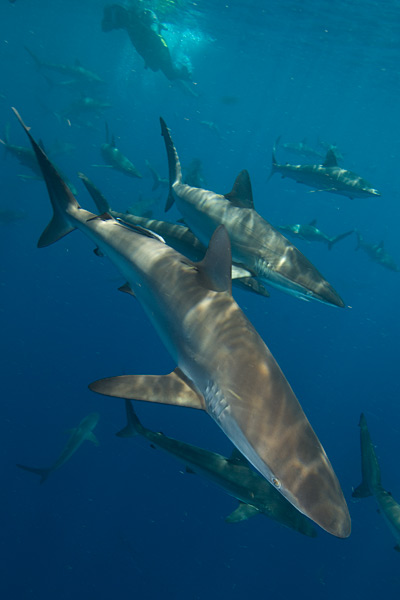
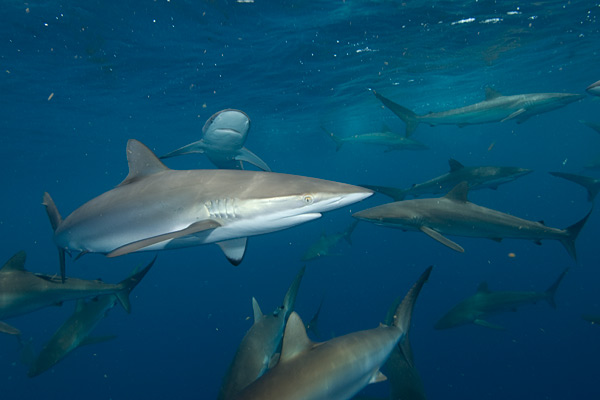
Last weekend we made the pilgrimage to Venice to dive with silkies and duskies. The duskies obviously didn’t get the memo but the oil rig that we dove at had so many silky sharks swimming around it that it was hard to remember that most shark species are endangered. For more than an hour we snorkeled around the boat in the presence of 100 or more sharks. The water was warm, the viz was great and the sharks were very, very friendly!

Venice is such a sharky place that it was the perfect location to reconnect with Eli, Paul and Nathan from Shark Diver Magazine. After two years apart we had a lot to catch up on and this was my first chance to introduce Claire to the team. Good times, good diving and some pretty good silky pics!

After Venice we drove east to the Gulf Coast Research Laboratory in Ocean Springs, Mississippi to meet with Dr Eric Hoffmeyer. Each month Eric and his team venture into the Mississippi Sound to monitor the shark population. The sound is home to thousands of small sharks, predominantly Atlantic sharpnose sharks but also finetooth sharks, bulls, blacktips, bonnetheads and a variety of other species.

Eric has collected a wealth of data on the sharks that migrate into his domain each summer and over two days out at sea I was able to sit and soak up more shark science than I ever thought my tired brain could handle.

Eric was kind enough to halt his work long enough for us to jump into the muddy water to photograph the sharpnose sharks that he released. The visibility was horrendous (about 3 to 4ft) but some of the images that we managed to get are surprisingly clear. One more shark to add to the Elasmodiver Field Guide at the end of the tour.

The majority of sharks that are landed are tagged, measured, fin clipped, blood sampled and swiftly returned to the sound but a few of the sharks that come up the line are DOA. These are brought back to the lab for further analysis and Eric invited us to join him in the lab to document the dissection process. It was a side of shark research that I haven’t been exposed to very much and it was a bit gory but fascinating to watch this aspect of his work.

After our Florida leg we are planning to head back to MS to work with Eric again.

For the sharks,

Andy Murch

The Shark Tour Blogs: Catalina Island Angel Shark

Saved by an Angel (Shark)

September 25, 2009 by sharkdiver

Saved by an angel (shark).

5th May 2009

In retrospect, driving north from San Diego when the bad weather hit may not have been the brightest thing to do. Refugio and Tajegis beaches were so churned up that we didn’t give them more than a cursory glance.

By the time we hit Monterey the surf had wrapped right around the headland and was hammering the usually tranquil inner harbour. We talked to shark researcher Sean Van Sommeran who conducts an annual elasmobranch distribution study at Elkhorn Slough north of Monterey. Sean has a lot of experience working with smoothhound sharks but his organization (PSRF) has not geared up for the season yet. Although he was very friendly and gave us all the pointers he could, it was obvious that mother nature was not going to favor us this time.

We retreated to the world famous Monterey Bay Aquarium and I spent a frustrating but enjoyable day watching the leopard and sevengill sharks swimming around their tanks. Claire spent her entire time among the sea dragons and pipe-horses. Apparently, they are as interesting to some people as sharks but I don’t get it.

Rolling with the punches is an important part of shark photography. Surface weather, underwater visibility and sporadic shark appearances are all factors that can wreck a trip when luck doesn’t run your way. Patience and the stubbornness to keep returning to a location for that illusive encounter are critical traits for anyone who thinks they might like to pick up a camera and become a serious shooter.

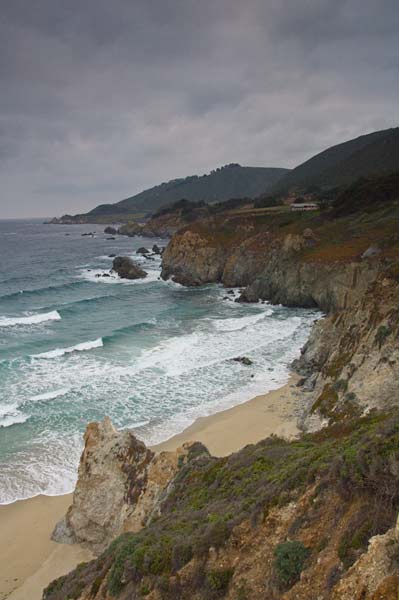
Sean graciously invited us to accompany him later in the summer when the weather will probably be better and with that idea in the back our minds we headed back south through Big Sur (a breath taking stretch of rugged so-cal coastline) and caught a ferry to Catalina Island.

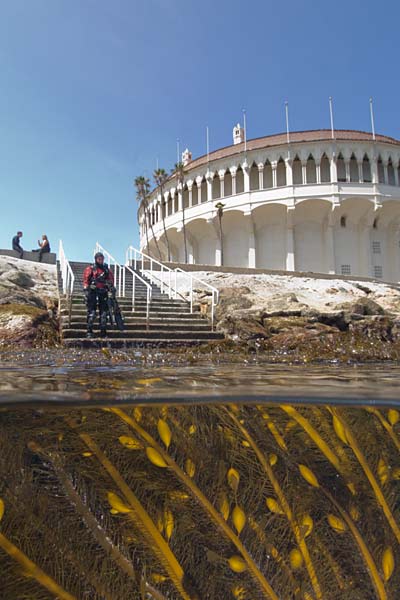
Left: Big Sur. Right: Claire jumping in at Casino Point, Avalon, Catalina Island.

Sadly, the promised torpedo rays had come and gone from the marine park three weeks before our arrival. For three days we scoured the sea floor hoping to find a straggler limping over the sand but it was not to be.

At night we hooked up with Jon Council who taught me to fly submersibles many years ago. Jon having done thousands of dives around Catalina gave us his take on the torpedoes. Apparently off the western side of the island there is a deep reef known as Farnsworth Bank. According to Jon and confirmed by other local divers, torpedo rays regularly gather in great numbers along this reef and those intrepid divers that are prepared to risk the extreme narcosis that accompanies diving to 190ft may be rewarded with the site of dozens of torpedo rays literally laying on top of one another. Intriguing but very scary. Compared to most divers I get ‘narked’ very quickly so I am not the ideal candidate for very deep air diving. Jon suggested that we go there when Claire and I return to Cali at the end of the summer to look for smoothhounds. He offered to arrange a boat and bring scooters so that we don’t have to kick too hard at depth which brings on narcosis that much quicker. Claire, is not convinced.

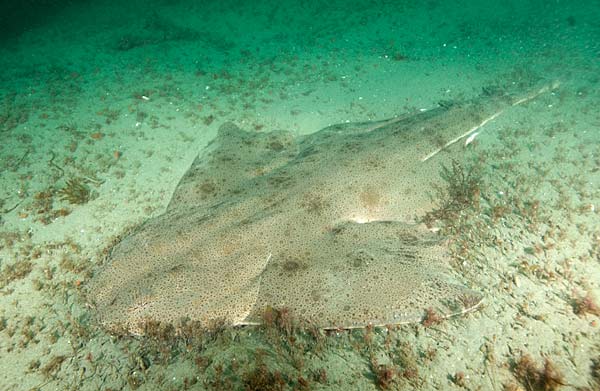
Although the torpedoes eluded us on this occasion, the trip was not a complete washout. On our second day on Catalina we found a sleeping Pacific angel shark near the wreck of the valiant at about 90ft. Angels are very patient sharks and although it was completely buried under the sand when we arrived, it let me settle beside it and dust practically all of the sand off of its back without it moving a muscle.

This was only my third Pacific angel and the clear water around Catalina resulted in much sharper images than I could have gotten on the mainland.

We also came across a number of California bat rays but they are notoriously difficult to approach. Each time I saw the telltale plume of sand that indicated a bat ray was feeding nearby I would try to hold my breath and swim slowly up to it. It never worked. On our last dive in the park I stumbled upon one more bat ray and decided to try a different tactic. Kicking furiously I swam straight at it with my camera strobes blazing. Surprisingly, it worked quite well. The bat ray froze as I appeared in front of it and I managed to get some colorful head on shots before it came to it’s senses and darted away.

That was our last west coast elasmobranch and brought our tour total up to 13 species in five incredible weeks.

The next morning we dragged all our gear back to the mainland and headed east. 2 days and 1500 miles later we arrived in Houston to catch up with Shark Diver Magazine shooter Paul Spielvogel and to visit with Jerry and Melanie from Kickady Scuba who recently became the US distributors for Poseidon.

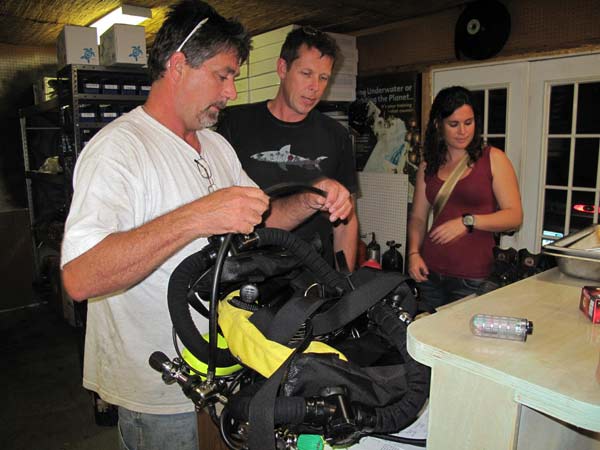
Jerry had me drooling over Poseidon’s latest Closed Circuit Rebreather.

We now have one day to rest, catch up this tour blog and prepare for the east coast leg of our adventure. Tomorrow we leave for Mississippi to accompany Dr Eric Hoffmeyer’s research team out to the barrier islands to look for a number of shark species that are rarely encountered by divers. We’re very excited about the opportunity to shoot some unusual sharks and to document Eric’s work.

After Mississippi we are heading to Venice, Louisiana to join Captain Al Walker and Eli, Nathan and Paul from Shark Diver magazine on a one day hunt for Dusky sharks and scalloped hammerheads. It just keeps getting better!

for the sharks,

Andy Murch
The Shark Tour Blogs: San Diego Sevengill Sharks

Sevengill Sharks in San Diego

September 25, 2009 by sharkdiver

Sevengills in San Diego

24th April 2009

We have just left San Diego but we will definitely be back! San Diego is one of the sharkiest cities in North America period.

To recap, we arrived just over a week ago to storm like conditions and had to sit around frustrated while the waves pounded the shore line. After a couple of days the weather abated and we were able to get out with our good friend Walter Heim who found us some beautiful blue sharks to shoot. See our previous blog Blue Dogs off San Diego.

Walter’s friend Dave Hinkel (Owner of Blue Abyss Photo) was also on the boat and he was kind enough to give us some pics of us in the water with the blues.

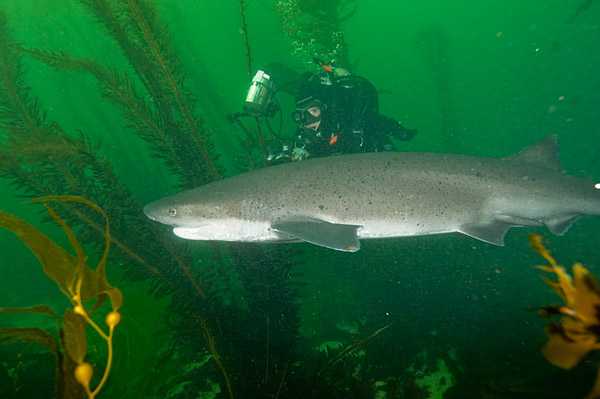
After boat diving with Walter we heard that there had been a broadnose sevengill shark sighted in La Jolla Cove. We have always wanted to dive the cove so we arrived early and kicked out to the kelp forest cameras at the ready. We didn’t really expect find a sevengill shark but we had also heard that the cove is a good spot to find horn sharks so we were excited either way.

The forest is a fair distance from shore and as we wound our way back to the beach, looking under ledges for horn sharks, a curious sevengill suddenly materialized out of the kelp and did a quick circle around us. If you don’t know your sharks you could be forgiven for not understanding how unlikely this encounter was. Looking for horn sharks and finding a 7ft sevengill is like looking for nickels on the beach and digging up a diamond ring. Local divers that dive the bay every week may see a sevengill once a year or so if they’re very lucky. I don’t even know how to describe our luck in seeing a sevengill on our very first shore dive!

The shark let me get a couple of snap shots. Nothing particularly great and I couldn’t get in front of him no matter how fast I swam but at least we were able to record the moment.

I think Claire was in shock through the entire minute long encounter. She told me later that she was torn between shooting the shark and modeling for me to give my shots a sense of scale. As usual she did a great job.

After that we were hooked. We returned to the beach and switched out our tanks and dove straight back in but the illusive broadnose sevengill had given us our moment of contact and we spent the next three dives at the cove shooting horn sharks, banded guitarfish and shovelnose guitarfish.

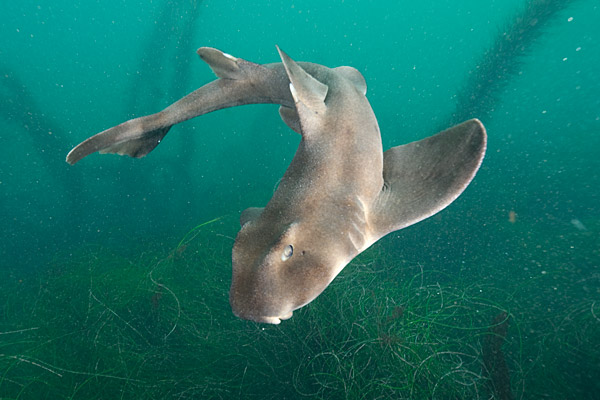
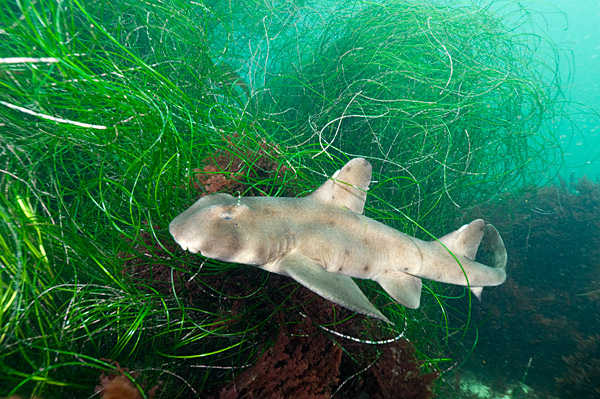
The horn sharks made great photo subjects. We were able to shoot them hiding in crevices and swimming over the brilliant green sea grass beds that waved back and forth in the surge.

The banded guitarfish were the same species as the ones that we shot in the coral reefs in the Sea of Cortez. It is quite surprising that they are able to tolerate such temperature differences. Shooting them in kelp made a nice backdrop instead of coral but I now have so many banded guitarfish shots that I really have to start deleting some off my hard drives.

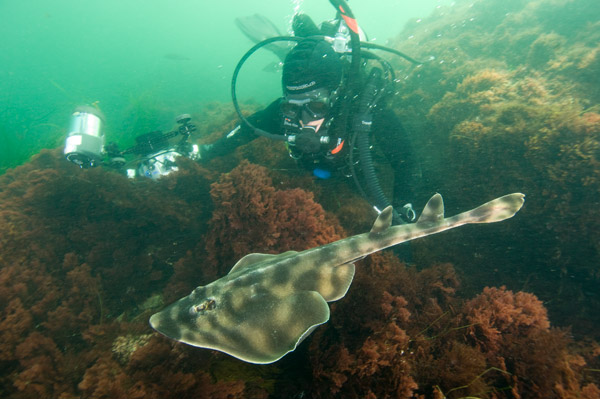
The other guitarfish that we encountered, the shovelnose, is usually a very skittish subject. I have tried to shoot this species at the beach and they invariably explode out of the sand in a puff of silt and swim for the depths before I can get anywhere near them. We were a long way off shore when I found this one in the kelp forest and I think it was a little surprised to see me. Even so, I only got one shot off before it returned to its senses and headed for the hills.

Between dives we drove over to the Marine Room which is a snorkeling spot named after the restaurant of the same name. This is the best place on the planet to find leopard sharks but it was a little early in the year for the leopards to congregate in big numbers and I could not see more than some shadows in the distance – just one more reason to come back to San Diego.

We also tried a night dive at La Jolla shores in search of angel sharks but after an epic surface swim and a long, freezing cold night dive we returned to the shore empty handed. That isn’t such a big deal as we are heading up to Tajegis Beach near Santa Barbara soon. Tajegis is a good spot for angels but a bad spot for surge so if we are lucky enough to arrive there when the weather is cooperating we will get one more kick at the can.

We had planned to slowly work our way up the coast to San Francisco but the forecast for shore diving is not good so we have decided reverse everything and get to San Fran as fast as we can and then slowly work our way back down to San Diego before cutting across to the Gulf of Mexico to start our east coast leg.

Another development that we just couldn’t pass up; we have decided to squeeze in a trip to Catalina on the advice of Ron Clough who conducts the California Shark and Ray Count. I have never seen a Pacific Torpedo Ray so Ron (who’s advice has always panned out in the past) gave us the skinny on where to reliably find pacific torpedos:

“Torpedos are at Catalina Island, Casino Point. Go deep, 70-90 ft. out toward the corner buoy on the left hand side, as you stand on the stair case facing the ocean. I’d give you a 99% chance. Also, look forward to great vis there and some great shots. Hope I get a chance to dive with you.” With advice that detailed how could we resist! So, we are cutting the Grand Canyon off of our itinerary (it’s just a big hole in the ground anyway) and penciling in two days at Catalina.

Our east coast shark diving itinerary for May is starting to fall into place so if you’re anywhere between Texas and Florida come out and say hello.

For the sharks,

Andy murch

The Shark Tour Blogs: Life and Death in Mulege

Life and Death in the Sea of Cortez

April 17, 2009 by sharkdiver

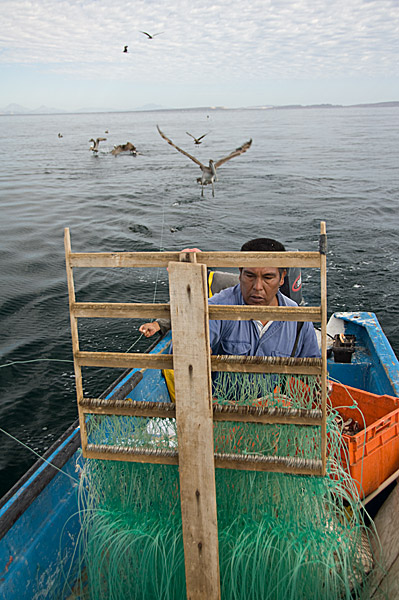
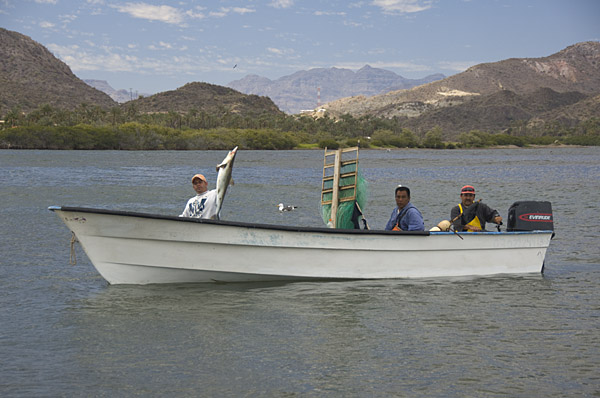
After striking out with the fishermen in La Paz we headed north. For the past few days we have been camping on the beach near the dusty little town of Mulege about a third of the way up Baja’s east coast. Initially we thought that this would be a place that we could shoot all the species of round stingrays that are common in this region but after chatting in my terrible Spanish to the longline fishermen that work the bay I managed to convince one Captain (Martén) to let me accompany him and his crew on one of their longlining trips.

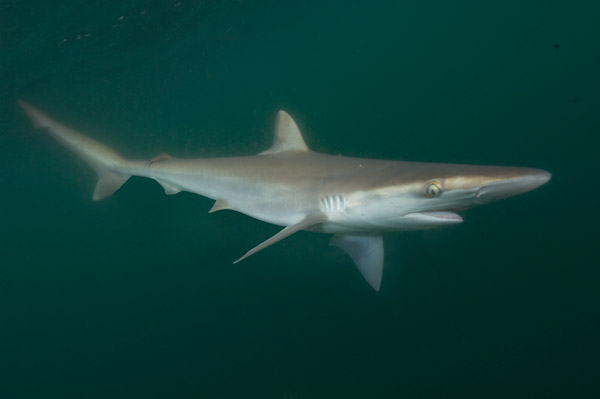
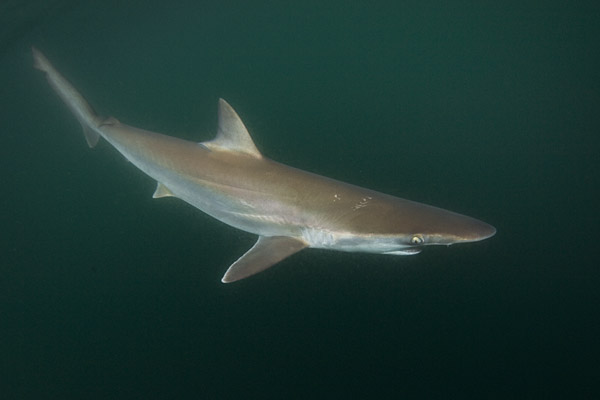
The boats mostly bring in tiny Pacific sharpnose sharks and (over the winter) juvenile smooth and scalloped hammerheads. When I told the fishermen that I wanted to jump in the water with the sharks they thought that I was a little crazy but they were ok with it as long as I didn’t get in the way.

We set out early in the morning but it took a long time for them to get any sharks. In total they put out four kilometers of longlines containing 1400 hooks baited with chunks of yellow striped fish that looked like some kind of grunts. For their effort, the fishermen landed 7 sharks weighing a total of around 20kg. I asked José, the other fisherman who has been in the industry a long time, what it was like in the old days. He told me that 20 years ago on his best days he could land over 1700kg of sharks.

Rows of shark hooks ready to be baited

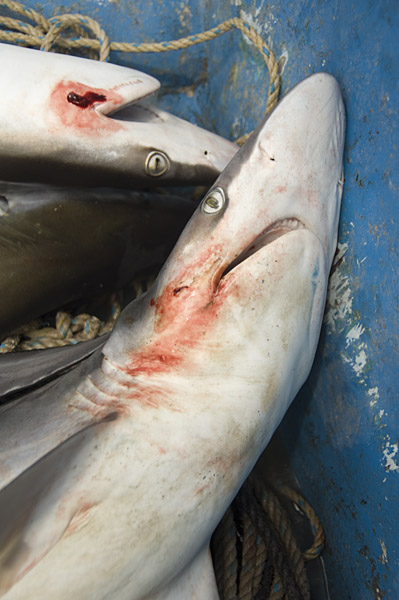
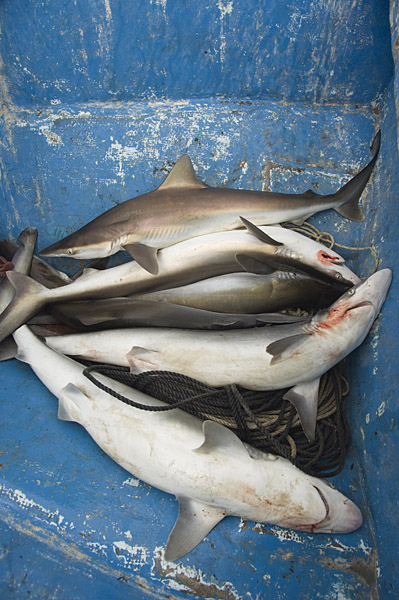
I spent my time swimming around the panga shooting the sharks as they came up the line. It was a depressing thing to document. The sharks were still alive but beyond recovery by the time they were tossed into the bottom of the boat.

I took some shots of the carcasses and then sat there wondering if I was really cut out for this kind of thing. I believe that getting images of long liners doing their work is important from a conservationists perspective but to sit idly by while sharks are left suffocating in the bilge of a panga is a tough gig.

80cm long Pacific sharpnose sharks piled in the bottom of the panga

While I sat there, José pulled up a very lively sub-adult sharpnose shark and tossed it at the others. It immediately started flapping around so I figured this one still had a chance. I asked Marten what he thought this shark weighed and he said around 1.5kg. They had already told me that they get just over a dollar per kilo from the traders that periodically show up to buy the sharks so I explained as best I could that I would like to buy this particular shark. They got the idea and from the bemused look on their faces they obviously thought that I was completely loco but they agreed to sell me the shark and I grabbed it gently in front of its tail and dropped it back in the water before it could beat itself senseless on the deck planking. Two bucks for the life of a shark! What would it cost to keep these fishermen home for good?

Possibly these are the first images of a free swimming Pacific sharpnose shark

I know that I didn’t really achieve anything by liberating one little Pacific sharpnose shark but maybe my token act had some effect even if it was a small one. After I released the shark we talked as best we could in broken Spanish about the problems that sharks are facing and their important place in the ecosystem. They already understood the big picture maybe even better than me. I asked them what they would do if they couldn’t fish for sharks and they shrugged and said that they would fish for something else. Doing anything other than fishing seemed to be a bizarre concept that they did not want to entertain. If any real change is to take place it will have to come from the next generation.

Marten’s son in Law Aaron proudly holds up a sharpnose shark

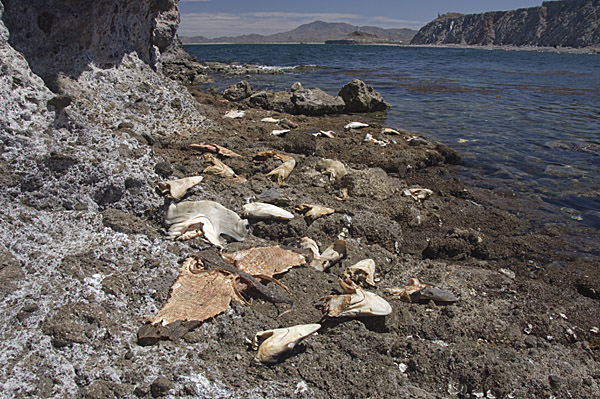
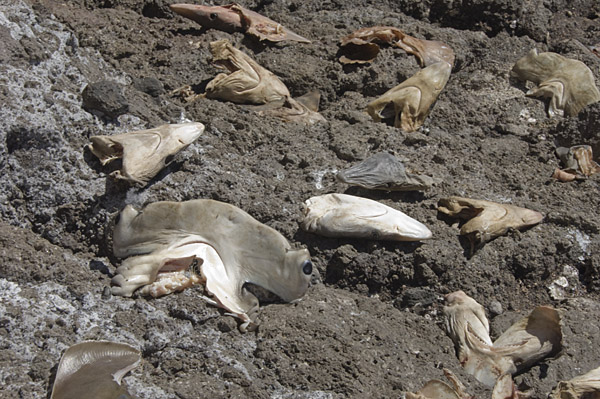
After bidding farewell to the fishermen Claire and I went for a long hike along the rocky shore north of Mulege. Just before sunset we spotted some birds in the distance and went to investigate. What we found was a shoreline littered with discarded shark and ray heads. It was a tragic site. They were mostly Pacific sharpnose sharks and small smooth hammerheads but there were also a number of guitarfishes and the carcass of a butterfly ray. All in all it was a grim day.

Discarded shark heads littering the shoreline north of Mulege

The next day we returned with our cameras to photograph the grizzly remains and then spent the afternoon chasing round stingrays in the shallows next to our campsite.

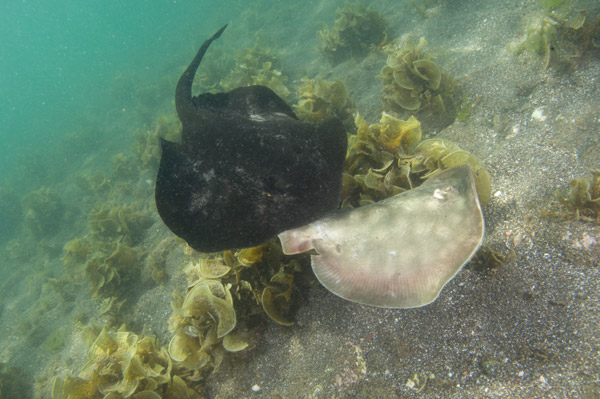
In 5ft of water the stingrays were everywhere. It was a refreshing change to see so much life after so much death. We must have seen two or three hundred rays. Mostly round stingrays and a few Cortez stingrays.

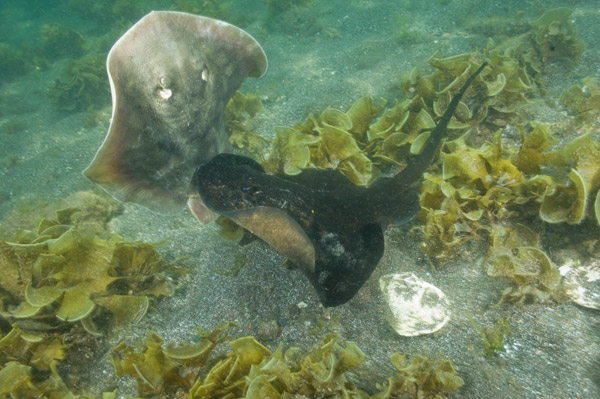
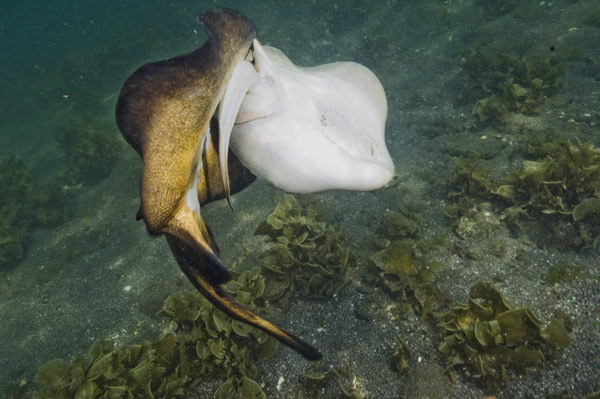
The rays were very skittish and exploded out of the sand and darted away as we approached their hiding places but one older male round stingray let me get really close. I followed him around for a good half an hour and just as I was planning to head for shore he ducked down and latched onto a female ray that was sleeping under the sand. For the next 5 minutes I was able to watch an amazing spectacle as the male ray struggled to subdue his mate. The female put up a valiant fight as they spiraled around and around each other oblivious to the flashes emitting from my camera system.

That night I slept a lot better. The balance of species may be shifting but at least there is still life in the Sea of Cortez.

Stingray porn – a male Round stingray (Urobatis halleri) latches onto the tail of a female before mating

We were planning to look for Mexican Bullhead Sharks further north in Baja but it appears that they are so rare that no one I have spoken to has ever seen one. So we have decided to spend a couple of days slowly driving north and then cross the border into Southern California. San Diego here we come.

For the sharks,

Andy Murch
Shark Pictures

The Shark Tour Blogs: Leaving La Paz

Leaving La Paz

April 7, 2009 by sharkdiver

For the last few days we’ve been based in La Paz trying to hook up with the artesanal shark fishermen that ply the waters on the north side of the bay. Last time we were here I managed to get some good shots of smooth hammerhead sharks but this time the fishermen are even more illusive than the sharks and we have had a great deal of difficulty tracking them down. I was hoping that we could document them while they fish for Pacific sharpnose sharks. This is their main target species that lives year round in La Paz bay and elsewhere along the coast. It is a fairly abundant little shark but it still needs to be carefully monitored to make sure that the sharpnose stocks do not fall to critical levels.

The fishermen average about 5 sharks per trip at this time of year but they take considerably more in winter. The sharks are too small (max one meter) for the Asian fin market but the locals relish the meat and the sharks fetch around 60 pesos (4US$) per kilo at the fish market. That makes their trips worthwhile even if there are not that many sharks around.

We’re planning to try one more time tomorrow to catch them at their fishing camp and then give up and move north.

The Easter holidays (Semana Santa) ramp up over the next few days. Easter is a massive event in Mexico and in Baja anyone with a tent heads to the beach. That means that the beaches around the main population centers down near La Paz will be zoos for the next few days. We want to get as far north as possible in the hopes that we’ll miss the flood of Mexican holiday makers but the chances are that wherever we end up we’ll probably still be swept up in the festivities. That’s ok; ‘when in Rome’ and all that.

I haven’t been in the water much since our last blog but I’ve still been talking sharks. A few days ago we met up with Documentary Maker Mike Hoover at the La Paz opera of all places. I haven’t seen Mike since our last trip to Guadalupe Island. Mike is a fascinating guy. His career in the film industry has been colorful, exciting and tragic in equal measures but his resilience and no nonsense astute personality are what I like about him the most. He is best known for his frontline work in Afghanistan during the Russian invasion and his cutting edge mountaineering films (among others) that have been well received by audiences around the world for decades. He has also worked on blockbusters like Forest Gump, Crimson Tide and The River Wild. More recently, he has been involved with numerous films about Great white sharks aboard his expedition ship the Captain Jack which is how I met Mike for the first time last year.

This time we only managed a short conversation before the singing started so I hope that I get another chance to talk and work with him soon.

Our next stop will be a day’s drive north on one of the white sand beaches around Bahia Conception. There are many beaches that we have never had the time to visit and some that are old favorites. All of them are home to hundreds of tiny Round and Cortez stingrays so we’ll be strapping on the snorkels once again and chasing rays until the sun goes down.

We wanted to keep this tour as fluid as possible but everyone we plan to visit has schedules so we’re slowly having to nail down dates for each adventure. The good news is that we have had a great response from all our friends and some once in a lifetime offers to do some very exciting diving. It now looks like we may be able to take a crack at sevengills in the wild with our shark tagging buddy Walter Heim. And, when we finally get to the Mississippi Delta we have an invitation to join a field trip with Dr Eric Hoffmayer from the Gulf Coast Research Laboratory. The GCRL is conducting an abundance and distribution study on coastal sharks and rays so that means that we will get to photograph lots of hard to find species like finetooth, Atlantic sharpnose, juvenile bulls and who knows what other sharks, not to mention all the illusive ray species that inhabit that part of the coast – I’ll be in elasmogeek heaven.

You can now follow our schedule at the following link:

http://www.elasmodiver.com/northamericansharkdivingtour.htm#Itinerary

For the sharks

Andy Murch
Shark Pictures