About Me

My photo
I am a Shark and Big Animal Photographer and the Founder of Big Fish Expeditions. I also pilot research submersibles on rare occasions but primarily I photograph sharks and rays. The shark images that I take have been used in many commercial publications but most importantly I try to concentrate on shooting rare and endangered species of sharks for conservation initiatives. It is a labour of love.
Showing posts with label shark pictures. Show all posts

Sunday, August 22, 2010

Big Fish Diving and Photography Expeditions

GROWING ELASMODIVER & OUR NEW SHARK DIVING EXPEDITIONS

KEEPING ELASMODIVER GROWING
Last year, more than a million people spent some time clicking through Elasmodiver's 400+ pages of information and shark images. Hopefully, some of them took away a little more knowledge and respect for our world's endangered Elasmobranchs.
It is important to me to keep expanding the shark and ray field guide, but as I slowly tick off the few remaining shark and ray species that are relatively easy to dive with and photograph, I find myself planning increasingly more abstract expeditions, often working with researchers and sometimes even commercial fishermen.
There are parts of the world like Southern Africa that I have been purposely avoiding. I could probably find a dozen new species in a week or two of diving around Cape Town but before I take off to such exotic locations, there are a number of elasmos from North America that still need some time in the spotlight. There are a couple of hammerheads from the Pacific slope that are virtually unknown and a number of Central American smoothhound sharks that are heavily targeted by the artisanal shark fishing fleets. Those species come first.

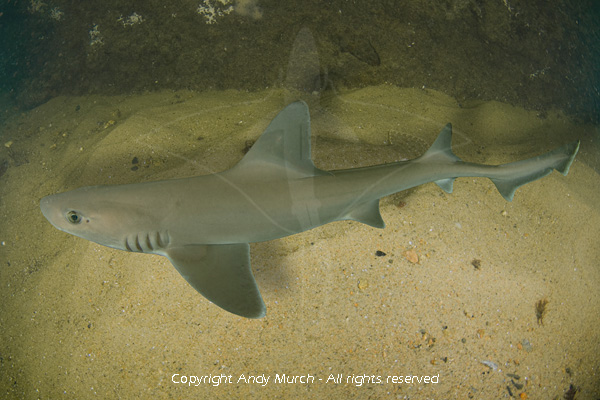
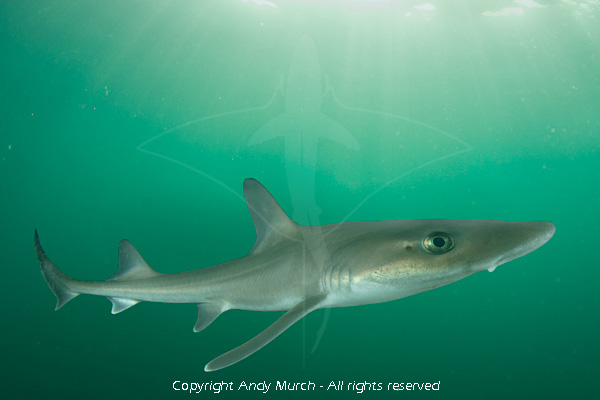
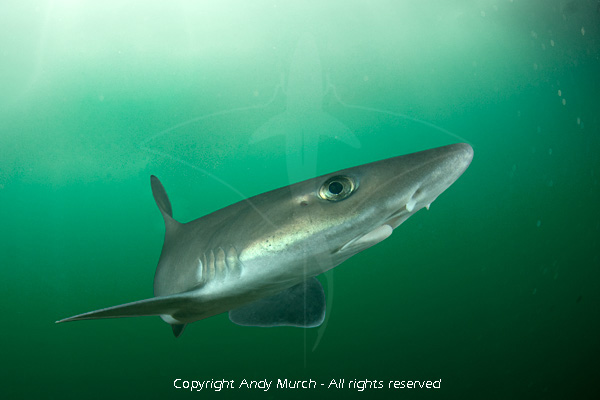
The latest shark species that was added to the Field Guide (a few weeks ago) was the Dusky Smoothhound. Smooth dogfish (as they are called in New England) are very common sharks but they are rarely encountered by divers.
Getting these images involved a trip back to visit my shark diving buddy Joe Romeiro in Rhode Island. Although we did everything we could to try to shoot a dusky smoothhound in the wild, we eventually gave up our fruitless search and found an aquarium that would let us shoot in their tank. A natural encounter would have been better but sometimes, this is the only way to get the shot.
A big thank you to Biomes Marine Biology Center for letting us work in their excellent facility.
  

SHARKFEST 2010
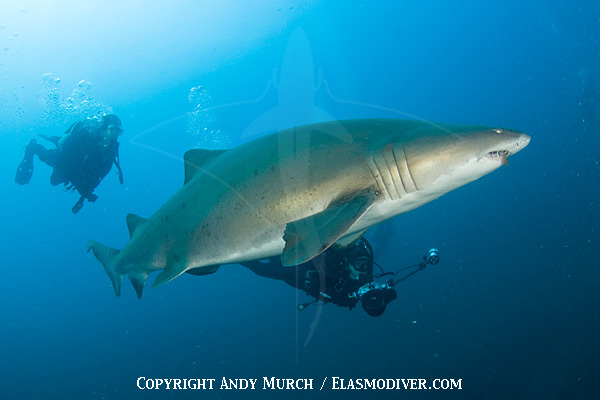
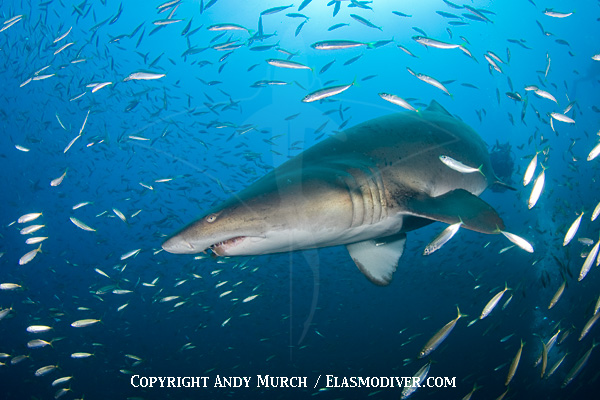
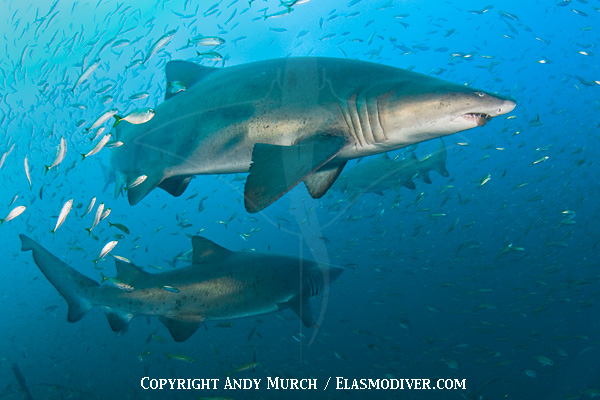
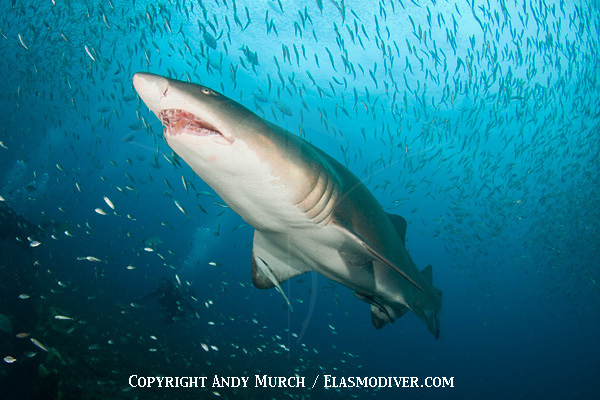
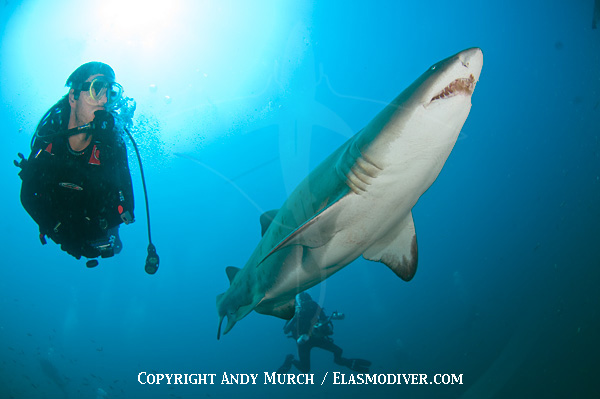
After many months of planning, a boat load of Shark Fanatics finally descended on Morehead City, North Carolina, for our weekend of shark diving, film screenings and good times. The whole event could not have gone better so we are planning to do it all over again next year - with a few very cool changes. Check out some of the great shark photos that came out of Sharkfest 2010 and find out what we have in store for next year: SHARKFEST 2010 TRIP REPORT
     

BIG FISH DIVING AND PHOTOGRAPHY EXPEDITIONS
If you know your way around Elasmodiver, then you'll have noticed that there are a lot of new links pointing to Big Fish Photography Expeditions. This is our brand new expedition website that showcases all of the trips that you can join me on to meet the world's top predators on their own ground.
These are not your average wildlife expeditions. They are one of a kind adventures tailored to adventurous people that want to enjoy up-close, in-water encounters with apex predatory sharks, whales, dolphins and even giant squid.

Our first expedition kicks off in February next year in Playa Del Carmen, Mexico. Playa has recently become a hot spot for bull shark encounters and the Bull Shark Feed that takes place there from November to March is second to none.
I am timing our bull shark diving adventure to overlap with a scientific shark tagging expedition which is being conducted by Dr Mauricio Hoyos who is Mexico's leading Great White Shark Specialist. Mauricio and I worked on a white shark film together a couple of years ago and he has agreed to do a talk about his white shark research on Guadalupe Island and explain what he hopes to learn about the bull sharks in Playa.
I have some great ideas for creating the perfect shooting environment and if the sharks cooperate I expect that we will return with some amazing images.

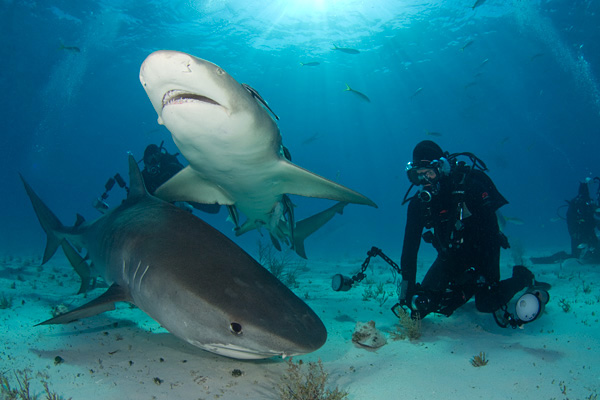
In April I will be running a second Tiger Beach Photography Workshop. This year's trip was a bit hit with scores of lemon sharks and 24/7 tiger shark action, not to mention encounters with reef sharks and nurse sharks too. For some people it was their first introduction to shooting big animals. For others it was a chance to hone their skills. I'm looking forward to getting back there and doing it again in 2011. Next year's boat is already half full so if you're interested in joining us please let me know as soon as possible.

I am also running trips to Cat Island in the Bahamas to shoot Oceanic Whitetip Sharks (only one spot left) and an amazing week long adventure, diving and shooting on the reefs of the Sea of Cortez which will include encounters with whales and giant humboldt squid dives
I guess that's more than enough bragging about expeditions. The ones we have scheduled so far are all listed on the Big Fish Photography Expeditions website. I'll update you on new expeditions that I intend to run, as soon as they come together.


WHATS BUBBLING...
This year is quickly getting away from me. Fortunately, late summer is the time when things start to get interesting here on Vancouver Island so I am dedicating the next month to the Pacific North West Elasmo Hunt.
Next weekend I will start by working on the wild west coast in an area called Barkley Sound which is a great place to track down sixgill sharks. I already have some sixgill shots but I'm hoping to improve them and get a much better variety that really capture the bluntnose sixgill's enigmatic personality. We have our bait crates ready to go and a boat rented for this very purpose. If any local divers want to join us on the hunt, there may be a few spots up for grabs.
Late summer is also when deepwater skates start making their way into the shallows to feed on crustaceans and other benthic invertebrates, so I'll probably be spending a fair bit of this month swimming around in muddy featureless bays, hoping to encounter a skate or two. Wish me luck!

For the sharks,
Andy Murch

Thursday, May 13, 2010

Dive in strange places long enough and you'll eventually see strange sharks and rays...

Dive in strange places long enough and you'll eventually see strange sharks and rays...

I spend a lot of time blogging about my future shark photography plans which can be fun, but its so much better to be able to write about successful adventures!

After shooting three new species of deep water skates in Rhode Island (see previous post), I flew down to West Palm Beach to meet up with a group of keen shark photographers that were accompanying me on the Tiger Beach Shark Photography Workshop.

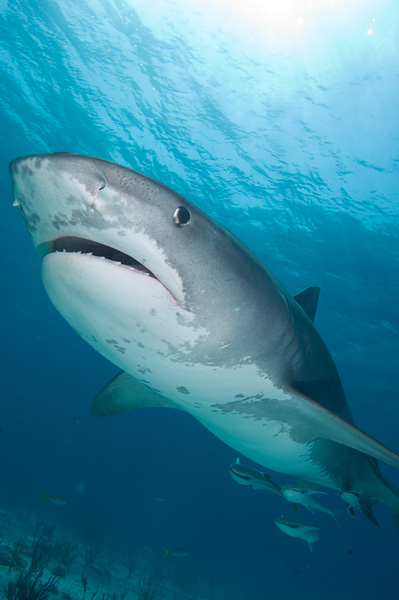
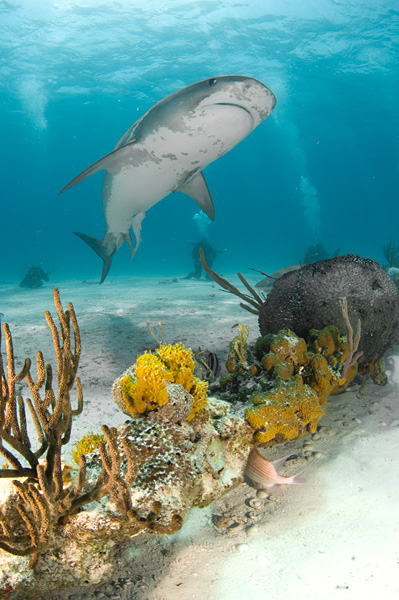
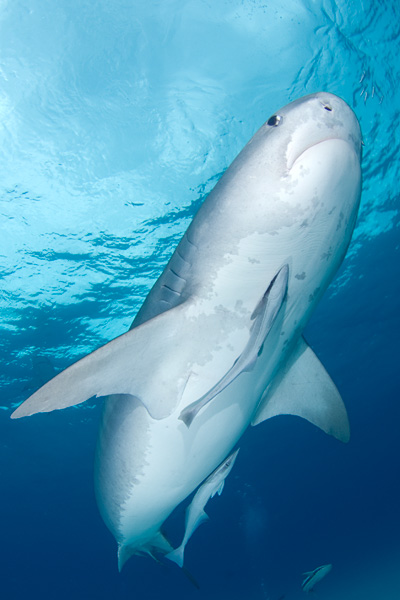
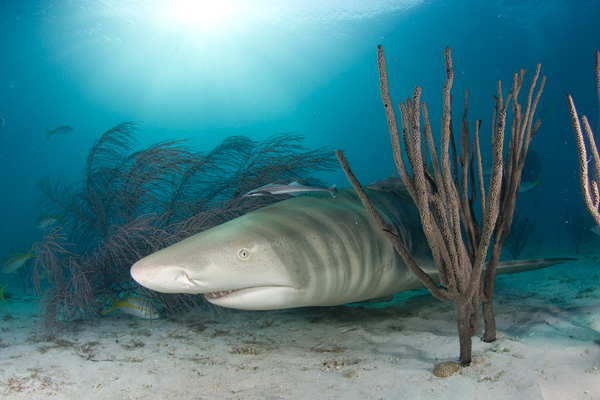
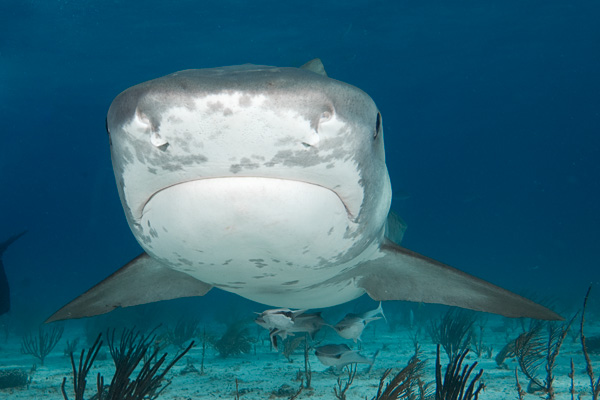
The expedition was a huge success. Tiger Beach always has a healthy supply of lemon sharks (usually around 40 or 50 once the chum gets going) but the tigers themselves can be hit and miss. Its important to have a solid player - a shark that isn't afraid of cameras, swims close to the group and stays around long enough for everyone to get the shots they want. Fortunately, that is exactly what we had. Other sharks came and went but one respectably sized tiger shark stayed with us for the entire week. I think that everyone got more tiger shark shots than they knew what to do with.

I wanted everyone to come home with great shots, a better knowledge of workflow (Bridge, Photoshop, etc) and some amazing stories about close up encounters with big sharks. I think everyone learned a lot and had a great time and I'm really looking forward to doing this again next year!

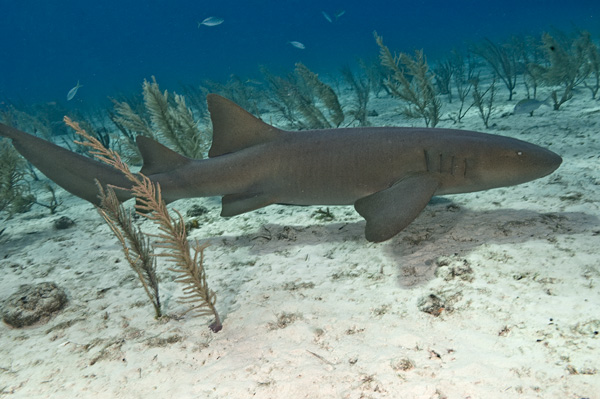
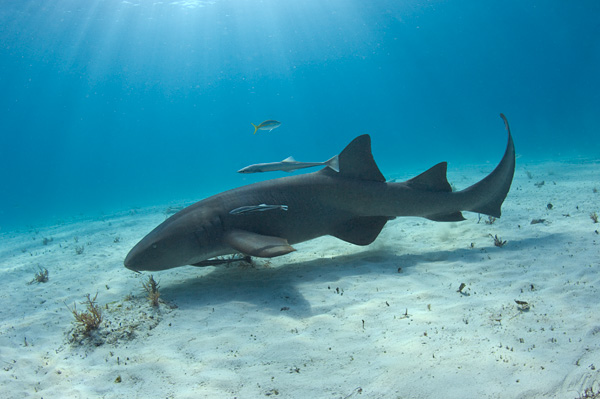
As well as lemons and tigers we had one little nurse shark that kept skirting the action. He was pretty brave to get as close as he did with all the huge carcharanids milling about but the poor guy never made it to the food.

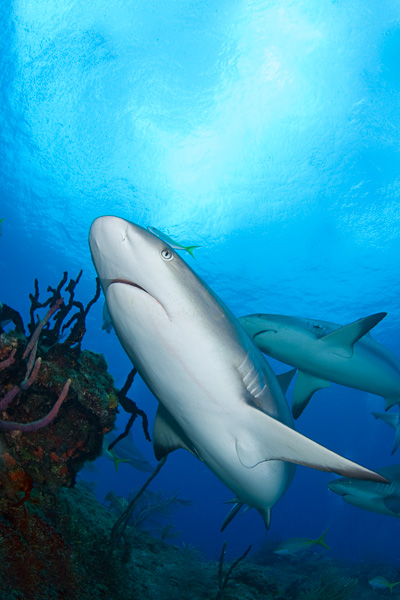
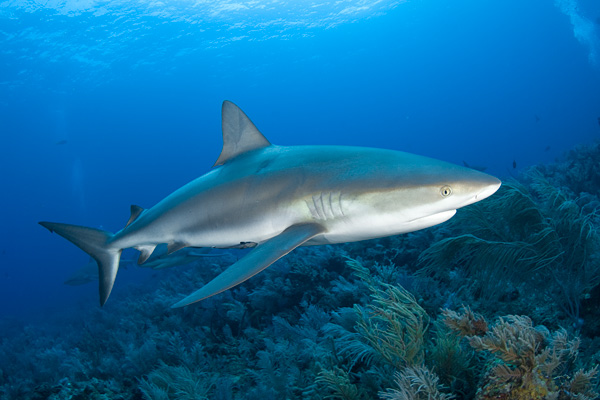
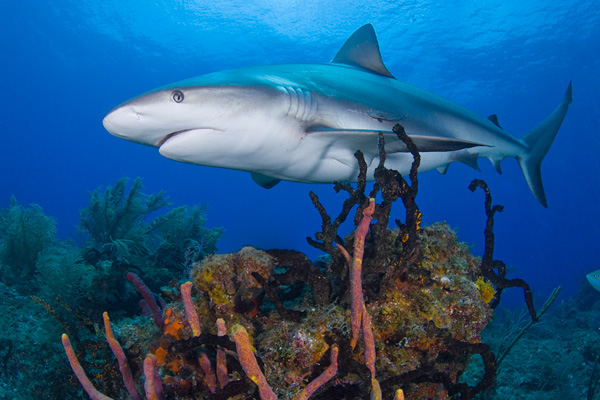
We spent the entire week exploring all the different photography opportunities that Tiger Beach has to offer except for one afternoon that we snuck off to a deeper site to chase Caribbean reef sharks. After the big lumbering lemons it was great to play with some zippy little sharks for a few hours. Everyone hunkered down next to the reef and snapped away while the sharks buzzed back and forth above us perfectly framed against the clear blue Bahamian water.

We returned to Tiger Beach to find our super model tiger shark still in residence and continued looking for the perfect shot until it was time to pull anchor and head back to Florida.

After bidding farewell to a boat load of new friends, I packed up my cameras and took a flight to Honduras.

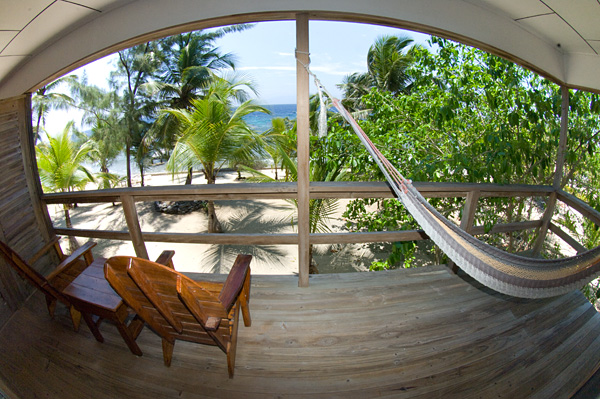
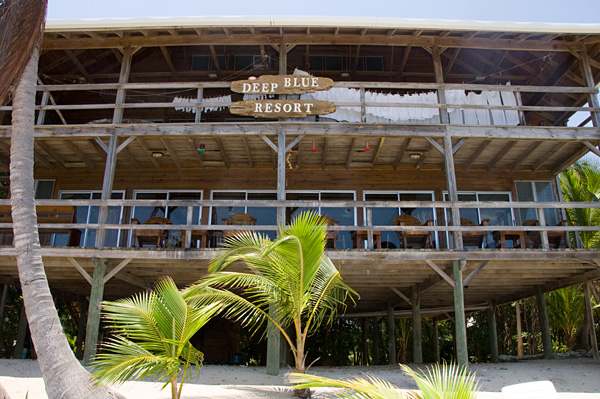
Steve Fox (Owner of the luxurious Deep Blue Resort in Utila) had graciously invited me to come and photograph a couple of deep water shark species that local fishermen sometimes encounter on the deep coastal plains around the island.

Both species we were after are rarely if ever photographed and both are data defficient according to the IUCN Red List. They are caught incidentally in other fisheries and like many deep sea species they are probably in decline. Sadly, if you chase rare sharks you have to expect to strike out now and then and on this trip the sharks eluded us.


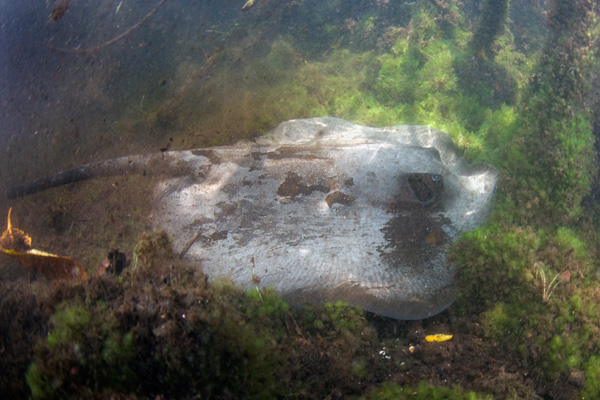
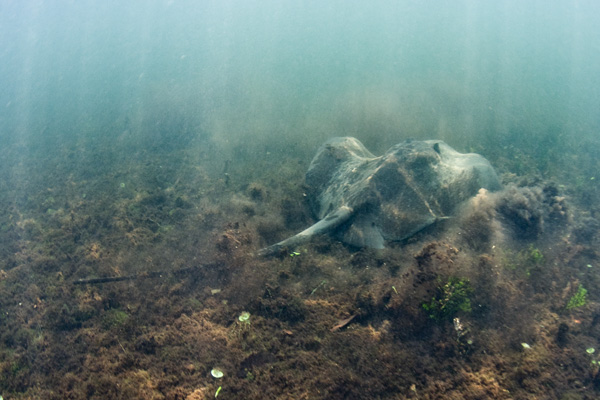
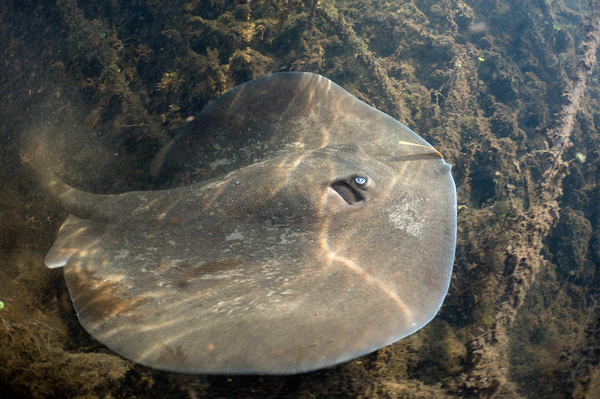
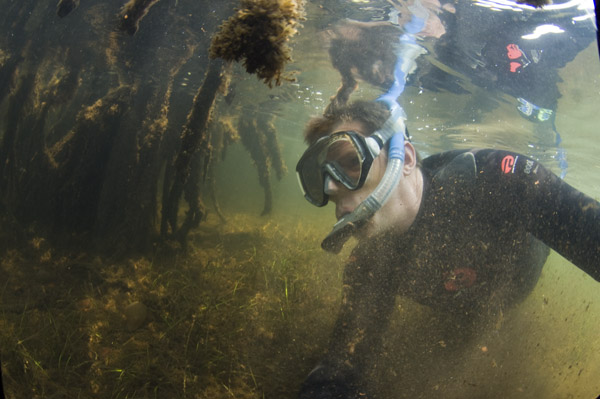
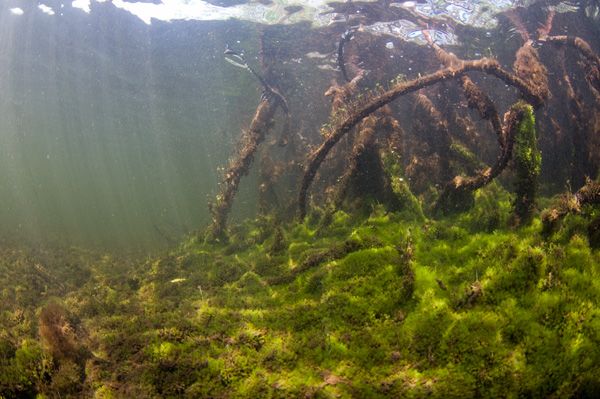
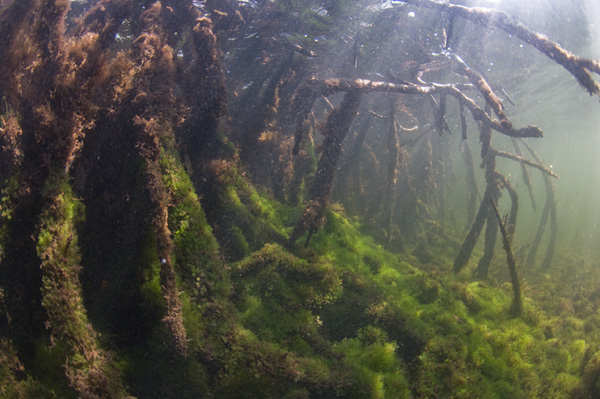
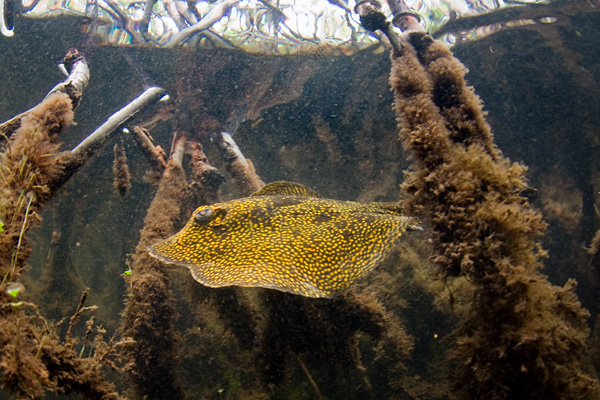
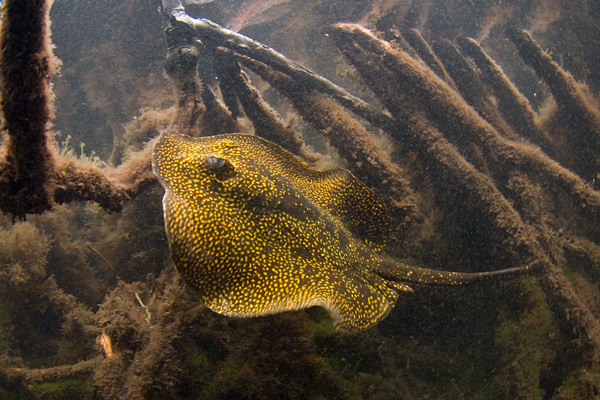
Cutting my losses, I spent the next week snorkeling in a muddy lagoon looking for a rare stingray called the chupare stingray (aka Caribbean whiptail stingray).

Steve (who has a cutting British wit) ribbed me relentlessly during the week when I wasn't able to find one. He was adamant that they were all over the place if only I'd open my eyes, but trying to shoot one in the low visibility environment was an extremely challenging mission.

Through a combination of luck and stubbornness, I finally cornered a ray in a pocket of mangrove and fired off a fusillade of shots while the ray kicked up more and more silt until there was nothing left to see.

Although I didn't get the quality of images I would have liked, I did take some usable ID shots so the trip was officially a success. One more species for the Elasmodiver Shark and Ray Field Guide.

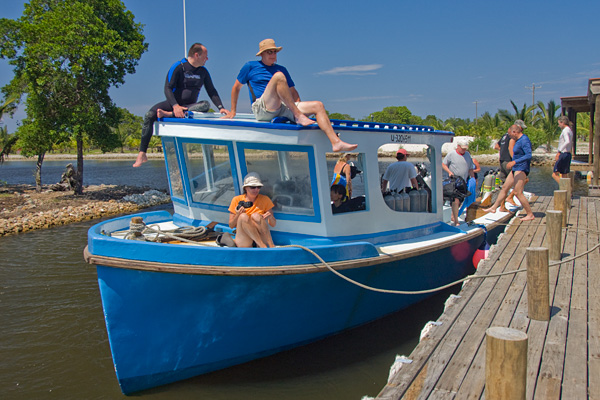
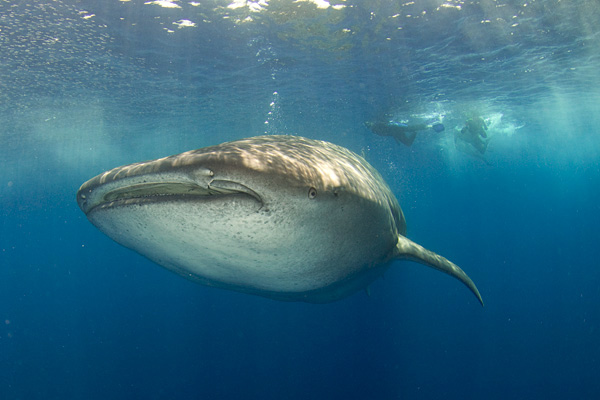
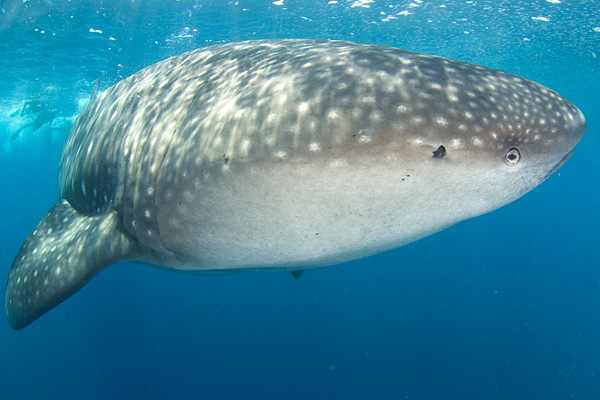
Tired of swimming around in lukewarm tea all day, I decided to take a break and head out to see some of Utila's beautiful reefs with the sensible divers. Deep Blue Resort has a seamless system for delivering divers to wonderful environments and encounters: After a leisurely breakfast, you simply stroll onto Deep Blue's private dock and get whisked off to a stunning and dramatic wall dive somewhere then climb back on board and slip out of your dive gear while the crew find you some whale sharks to play with.

Then you jump in, snorkel with the sharks (which are conveniently feeding at the surface on baitballs) and pop back onto the boat once the sharks move too deep. This is repeated time and again until the guests get tired of 'whale shark jumps' and ask to be taken to another pretty dive site.

After a pleasant lunch back at the lodge, guests are then invited to head back out on the boat for more absurdly easy diving or enjoy a shore dive on the house reef. After a week of paradise they all fly home feeling ten years younger. It's painfully easy.

I'm not jealous - really I'm not. But how come my dive trips more often involve squeezing onto a Central American school bus jammed full of locals that are carrying hundreds of chickens to some far away market. And then, sleeping on a grubby panga in the middle of the ocean with a bunch of fishermen that I can barely understand while waiting for a hapless shark to swim by. I think it's time I reconsidered my shooting strategy :)

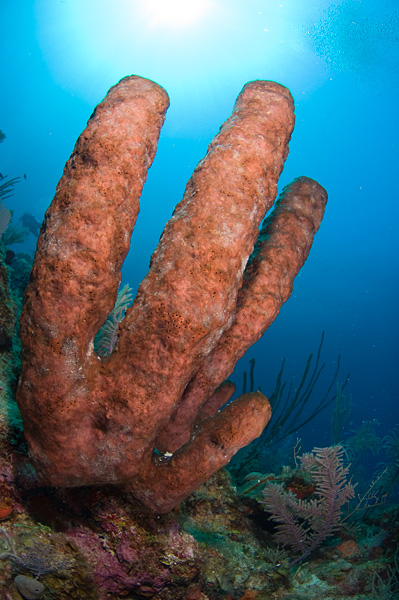
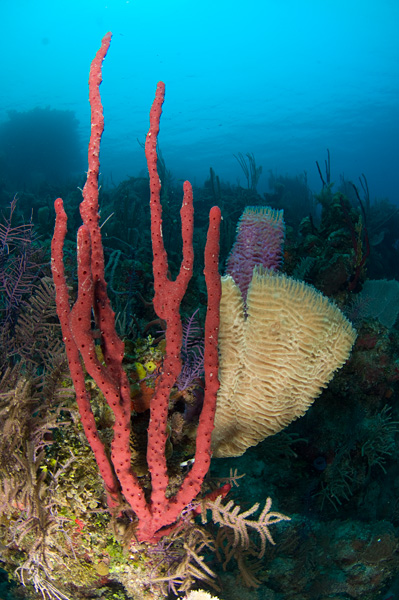
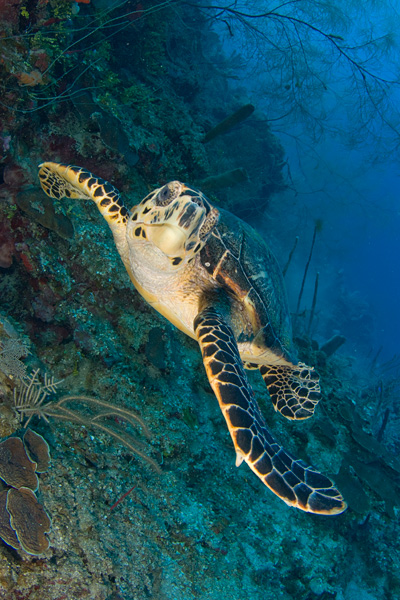
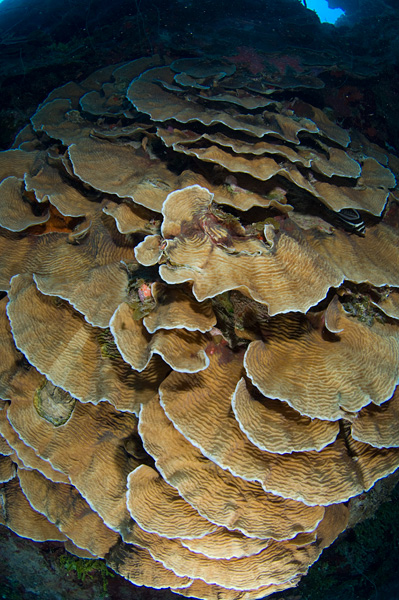
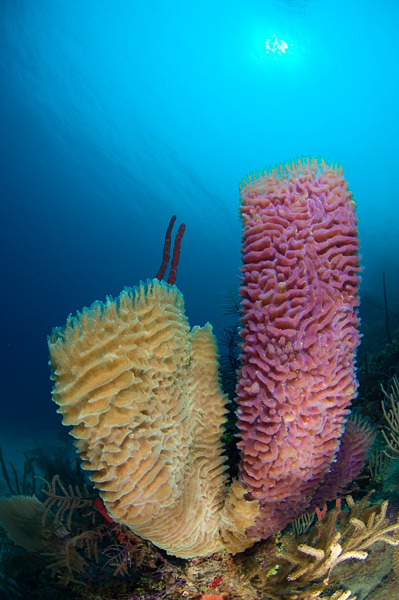
Its been so long since I did any 'recreational diving' that at first I couldn't remember what I was supposed to look at. After a while, I settled in and started shooting pretty sponges and coral formations but it still felt kind of weird not being on a shark photography mission. The whale shark jumps were much more familiar and I was happy to have the chance to snorkel (if only briefly) with a couple of big animals.

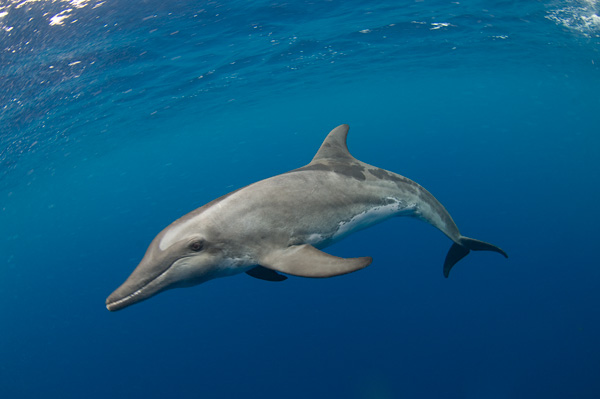
What was more unexpected was the pod of rough-toothed dolphins that we encountered. I am far from a marine mammal expert and I confess that I'd never even heard of rough-toothed dolphns. Apparently they encounter them on Utila fairly regularly and these ones were surprisingly playful. I was the only one free diving so the dolphins gave me a lot of attention and I came away with some very respectable images. I'd like to share them here but they are earmarked for a future publication. Here's one that didn't make the cut:

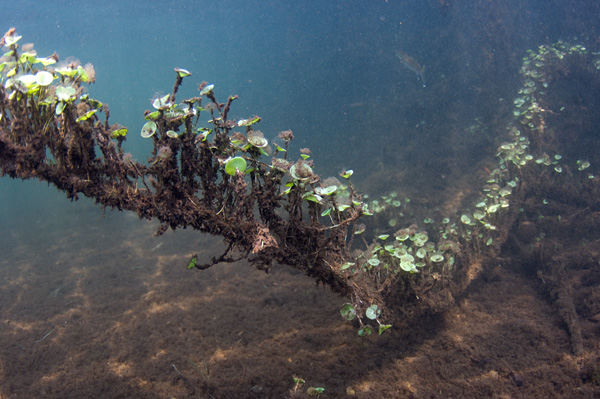
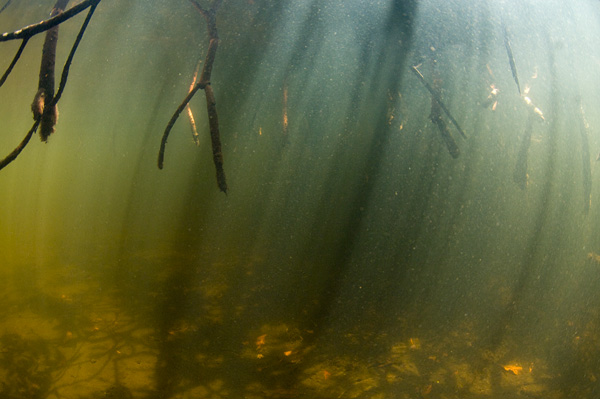
Having got my fix of big aquatic animals, I decided to head back into the lagoon for one more crack at the Caribbean whiptail rays. The vis had improved enough to see the mangrove forest in all its glory but the rays were nowhere to be found.

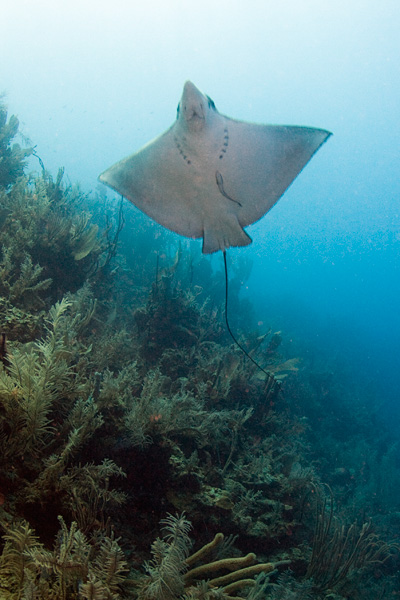
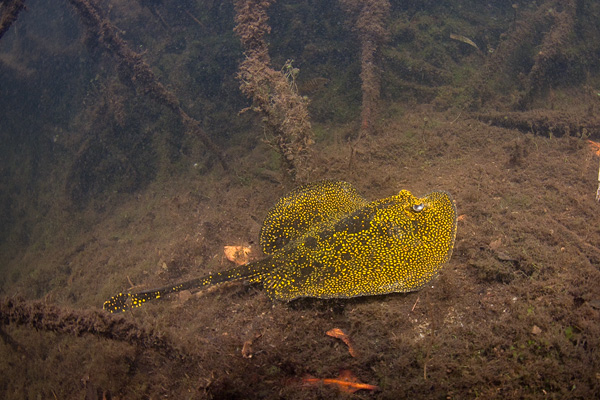
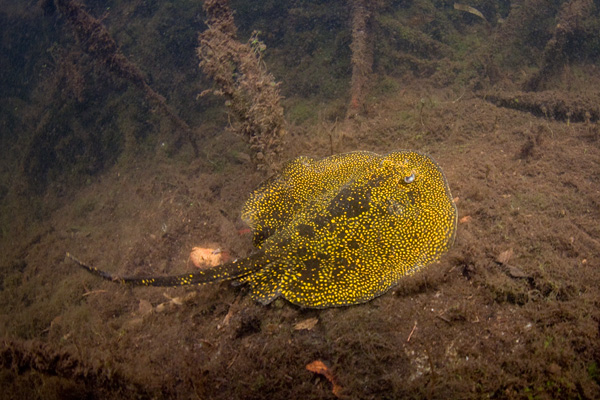
What I did stumble upon was a urolophid ray (round stingray family) that I can't positively identify. It was probably just a yellow spotted stingray but rather than the usual tiny yellow spots on a pale background this little ray was jet black with vividly contrasting orange/yellow spots. I've never seen this color variation before but then again I've never spent a week snorkeling around a Honduran lagoon.

Tallying up the elasmobranchs from the entire trip, over a 5 week period I managed to shoot nine species of sharks and rays and saw two more species distantly swimming along. Not a bad first adventure for the new decade.

Future plans...

I'm hoping to attend the American Elasmobranch Meeting in July in Providence, RI. If any of you sharkafiles will be there please let me know. After that, my next big trip will be Sharkfest. Sharkfest is three days of sandtiger shark diving with a mini shark film festival attached. It's my humble attempt to bring together a whole bunch of shark divers to dive, watch movies, tell stories and have some fun. If you would like to attend there are 3 spots left on the boat. Email me for details.

For now I'm back on Vancouver Island cleaning up pics, writing stories, diving with local species and plotting. I may be running an underwater photography workshop here in Victoria over the summer so if you're up in the Pacific North West and want to learn the basics of DSLR photography let me know!

For the sharks,

Andy Murch
Tuesday, April 13, 2010

An Incoming Tide of Adventure

Like a stingray stranded on a mud flat, I have been stuck on land for way too long. I spent the winter working in other fields to raise a shooting budget for 2010 and with that taken care of, its time to embark on a six week expedition through New England, Florida, The Bahamas and Honduras. The plan as always, is to shoot as many new species of sharks and rays as possible.

Right now I am in Rhode Island. Home to makos, blues, threshers, the occasional white shark and lots of deep sea skates. For those that don't know, skates are a type of ray and are therefore closely related to sharks. One big difference between skates and other rays is that skates lay eggs. They are also very specious. If fact, they are the largest of all shark or ray families and because most live in very deep inaccessible areas, scientists are still finding new species on a fairly regular basis.

I am particularly interested in shooting barndoor skates which Greenpeace International recently added to its Seafood Red List. Greenpeace's red list is a list of fish that are commonly sold in supermarkets around the world, and which have a very high risk of being sourced from unsustainable fisheries. On the other hand, NOAA recently downgraded the barndoor on its 'species of concern' scale but the continuing directed fishery and high by-catch levels make it an ever-vulnerable species.

You can't dive with deep sea skates in their natural environment unless you happen to own a research submersible. Sadly, a sub is out of my budget this year but I have a buddy named Brian Raymond who works on a fishing trawler that often plies the waters of The Georges Bank where barndoor and other skate species are fairly common.
You may think that its odd for a conservation minded shark photographer to be hanging out with a fisherman but Brian is no ordinary fisher. After 5 years in the industry he is very tired of being part of the problem. This summer he is quitting his job and going into business with Shark Film Maker Joe Romeiro. They will be running eco-friendly blue and mako viewing trips out of Rhode Island so if you're up this way and want to get in the water with some beefy New England sharks, give them a call: 333 Blue and Mako Shark Expeditions

The boat that Brian works on mostly trawls for squid but trawling is an indiscriminant form of fishing so the by-catch levels are often horrendous. Recently, they have been dragging in 1000ft where there are a number of vulnerable skate species so we worked out a plan to try a catch and release photo shoot with some of the skates that he rescued from the nets. It should have been a simple way to nail some shots of never before photographed species but the best laid plans can go awry.
While Brian was returning from his last fishing trip, I flew in, stashed my stuff at Joe's place and got ready to start shooting. Brian and his girlfriend Jen met me at a local beach and Brian pulled a tote of slowly flapping skates out of the back of his truck. When I found that he had managed to bring not one but three deep sea skate species I was as happy as a kid at Christmas.

The plan was for me to swim out to clear water and release the animals on the sand and rocks where I could get some usable ID shots before they swam away. I was petrified that they would bolt before I could get any images but that turned out to be the least of my problems.

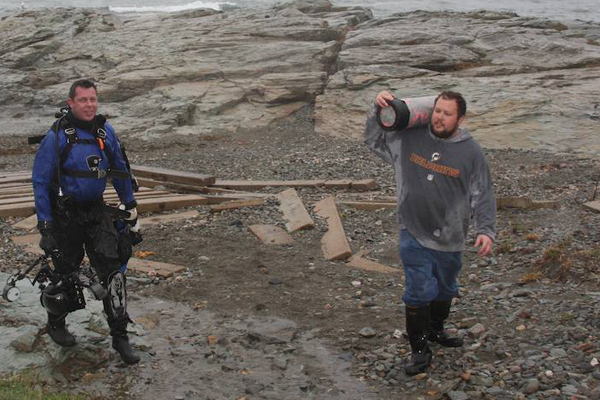
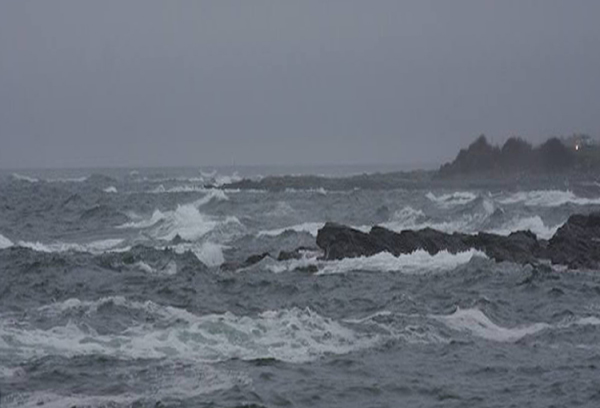
R.I. is recovering from the worst flood in 200 years which has thrown millions of gallons of dirty water into inshore coves like the one we were shooting in. To make matters worse, the day we chose to release the animals, the weather was far from ideal. Strong winds, lashing rain and turbulent seas made the whole swim out from shore rather daunting. I went out for a test run just with my camera and found the going pretty tough. It didn't help that I was nursing a fever and a throat infection and apparently my drysuit had somehow gained a lot of extra buoyancy over the winter :) leaving me considerably underweighted.

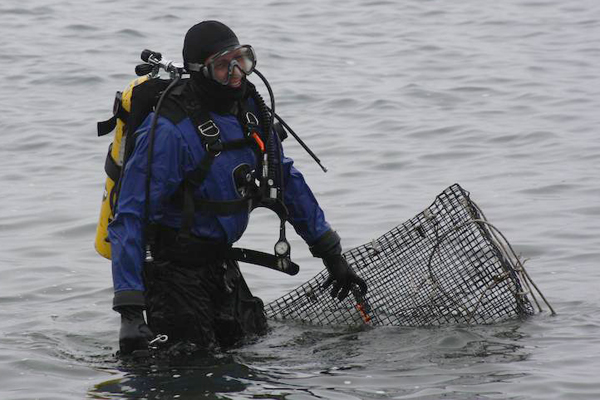
Unperturbed, I kicked back to shore, found some scrap iron on the beach and strapped it to my tank. Then, I filled my pockets with rocks and ventured out again, this time with my camera in one hand and a lobster trap full of deep sea skates in the other.

Clutching such a voluminous object in rough seas put me in an unexpected position. I found myself at the mercy of the rip which dragged me out of the bay into an area that was churning like a washing machine. Looking down, the visibility was so bad that I couldn't see my camera dangling at my side, let alone photograph marine life. I tried retreating but I could barely make any headway back to the beach and I was slowly drifting sideways onto a patch of submerged rocks that was throwing extra large waves in my direction.

I tried sinking under the buffeting chop but my drysuit inflator jammed open, lifting me back to the surface and filling my suit to Michelin Man proportions. I had no choice other than to disconnect the air hose but as the air trickled out, the sea trickled in and within a minute or two my suit was completed flooded.

Now I was starting to feel a bit uncomfortable. I'm not one to panic but I was riding so low in the water that I couldn't tell which way the shore was. While I was deciding whether I should drop the lobster trap (making the entire trip to New England a disaster) I spotted Brian waving from the rocks with a pair of binoculars around his neck. With new resolve I inched towards shore. Cage in the left hand. Camera in the right. KICK! Look up. reorient to shore. Head down. KICK!

It was slow going but I made it back into the shallows and dropped the cage in a sheltered spot to rest. There was no way I was heading out to sea again so I gently lifted a skate out of its confinement and let it go. The skate swam around a little and then settled onto the sand, cupping its body to provide the suction necessary to resist the surge that was still pulling me around.

By working with a fisheye lens within about six inches of each skate, I was able to get some images that looked like they were shot in much clearer water than they really were. After maybe an hour I dragged my wet and weary bones out of the bay and left the skates to find their way out to sea.

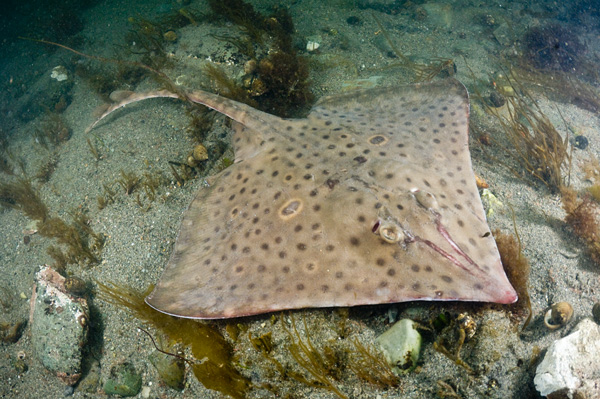
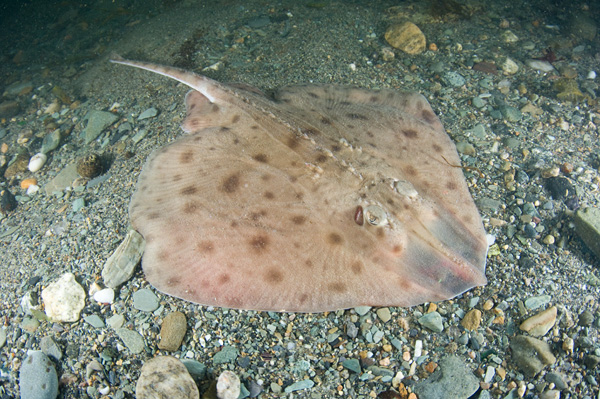
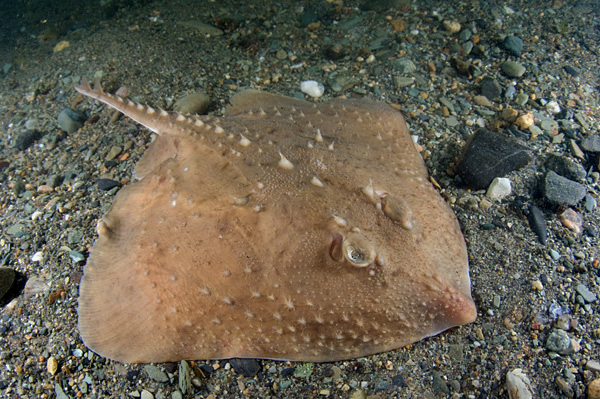
Barndoor, Smooth and Thorny Skates

That was two days ago and I'm still feeling whipped but the images came out great. Three more species for the Elasmodiver Shark and Ray Field Guide. Three more elasmos available for any conservation initiatives that might need images.

Next stop Washington State for a couple of days diving on the Olympic Peninsula with Claire and then I fly down to Florida to lead a week long Photography shoot at Tiger Beach in The Bahamas. After that, the trip starts to get interesting!

Sharkfest 2010

In other news, Sharkfest is getting exciting. As a new facet of the Predators in Peril Project we are starting a simple new campaign inspired by a constant flow of emails from people that want to do something to help sharks in their local communities. Its called the Shark Friendly Restaurant Initiative. The idea is for individuals to use fact sheets and decals that we will supply to approach restaurant owners in their communities that sell shark products (not just shark fin soup). If a restaurant agrees to become part of the solution, they get a Shark Friendly Restaurant Decal for their door and a listing in the Shark Friendly Restaurant Guide on Elasmodiver. Where possible, we will arrange for the campaign to be listed in local food and entertainment magazines so that conscientious consumers can learn what the decal looks like and patronize the right restaurants. Seafood Restaurants that already refuse to sell shark products get a decal right off the bat which will help to brand the idea.

What does this have to do with shark diving in North Carolina? Well, the campaign is being sponsored by the profits from Sharkfest. If I manage to fill the boat, we'll have a budget to print enough decals to get started. You can find out more about the campaign at this link: Shark Friendly Restaurants.

On a more fun note, we also have our first shark film submissions. The first to arrive was Big Fish Utila an excellent film about whale sharks in the Bay Islands. We'd like to have at least a dozen short films to view over the weekend so if you know anyone that has made a shark film recently or if you have a film of your own to submit, please tell us about it. Film submission is free.

There has been a lot of interest in the trip but there is still room so if you would like to come diving with Sandtiger Sharks with us and a bunch of other shark fanatics for 3 days in early August please let me know. Sharkfest is $640 which includes 3 days shark diving, accommodation, a Sharkfest 2010 T-shirt and our 'shark friendly' Barbeque.

One shark diver suggested that we include a sandtiger night dive in the agenda. That sounds like fun to me but I'd like to hear what you think!

TB2

The Tiger Beach Photography Workshop appears to be a very popular concept. I've never seen a trip fill up quite so fast. So... I'm considering running a second workshop/expedition in the fall. Email me if you're interested.

Lastly, Elasmodiver is getting out of control

Some people have commented that Elasmodiver is getting too big to navigate. No argument from me! So how do you get your head around a website with almost 500 pages? Its a puzzle but at least its easy to keep track of recent changes by bookmarking this link: Elasmodiver Updates. Its the simplest way to scan what is new, what has changed and when. And, if you have suggestions on how Elasmodiver could be made better, pleeeease let me know. Elasmodiver remains one of the largest sources of shark info on the internet. Help us keep it user friendly.

For the sharks,

Andy Murch