September 25, 2009 by sharkdiver Tagging Whale Sharks in the Gulf
14th June 2009
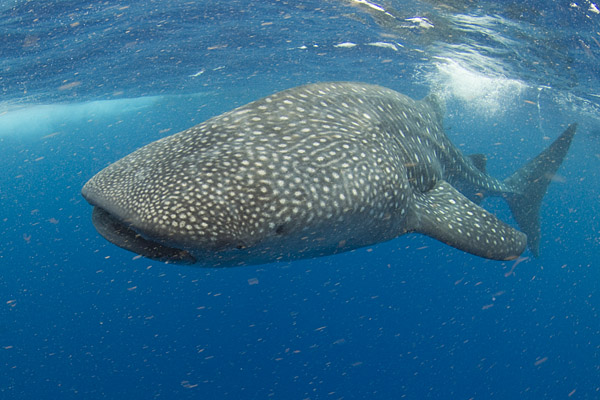
We are aboard the 67ft commercial fishing vessel Norman B which operates out of Leeville, Louisiana. The Captain/owner of the ship – Russell Underwood – has a deep fascination with the ocean that he has been sailing over for the last three decades. Last year he and his crew witnessed some large aggregations of whale sharks in which upwards of 100 animals came together to feed at fish spawning events around the northern gulf. Awe struck by this amazing sight he was inspired to hang up his fishing gear for a week and invite our gang of researchers and film makers on an expedition to record and tag the behemoth sharks.


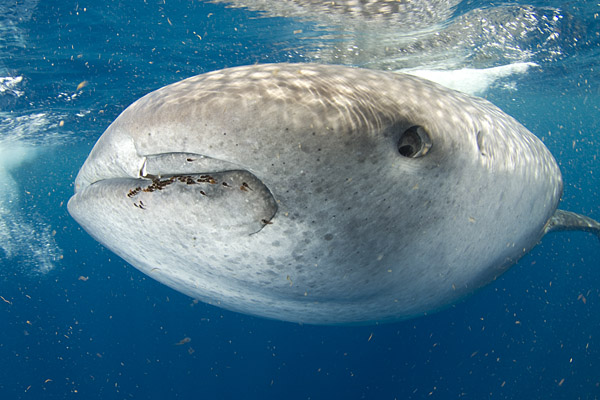
Over the past seven days we have witnessed around a dozen whale sharks feeding on dense floats of fish eggs which Dr Eric Hoffmayer will eventually identify once he returns to his lab in Ocean Springs, Mississippi.
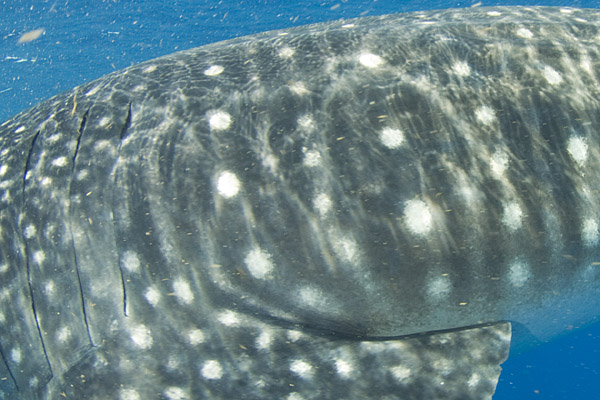
Claire and I were invited aboard to take i.d. shots of the sharks for the Ecocean inititive. This is an international database of individual whale sharks that have been positively identified by recording the unique spot patterns that occur behind the whale sharks left gill openings.

The composition of the markings in this area does not change significantly as the animal grows so it acts like a thumb print that can be entered into a program that utilizes stellar mapping software to match up images taken at different times and places. Potentially, this can be used to track the movements of whale sharks without using expensive (and invasive) acoustic or satellite tags.
We also had three sat tags on board that Eric was able to place on the sharks. In 8 or 9 months time these devices should detach, float to the surface and transmit their data to any satellites that are passing by.
On the third day I managed to crack a rib while pulling myself back into the chase boat. If memory serves that is my 15th broken bone which is a pretty sad testament to my clumsiness or maybe I simply end up in harm’s way more than most people. Either way, it made for some painful days and nights and didn’t help my struggle to keep up with the sharks.
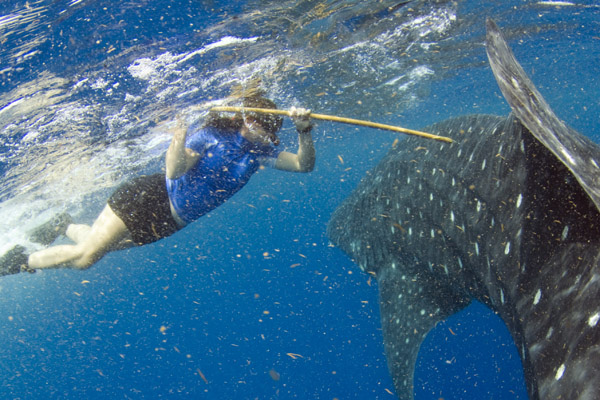
After we deployed all the sat tags we decided to spaghetti tag the other sharks so that we could tell which ones we had already swum with because one enormous spotted shark looks surprisingly like another. I stayed on thumb print photography duty but Claire actually got to tag a 25ft whale shark which she managed to deftly accomplish on the first attempt.

When you’re motoring across it, the gulf is a seemingly endless body of water and although whale sharks are the biggest fish in the sea, searching for them is like looking for the proverbial needle in a haystack. To find them we cruised along one tide line after another but you can only stare at blue water in search of fins for so long before you start to go bug eyed.
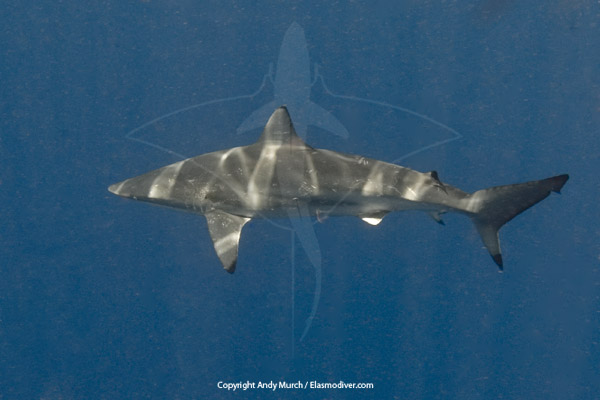
To break up the monotony, every day we tied up to one or two of the 5000 oil rigs that are sprinkled along the continental shelf. We wanted to chum up some predatory sharks that Eric was also interested in tagging. I think we were all surprised that at most of the rigs the sharks were a no show but at one particular spot we finally encountered a nice assortment of silky sharks.
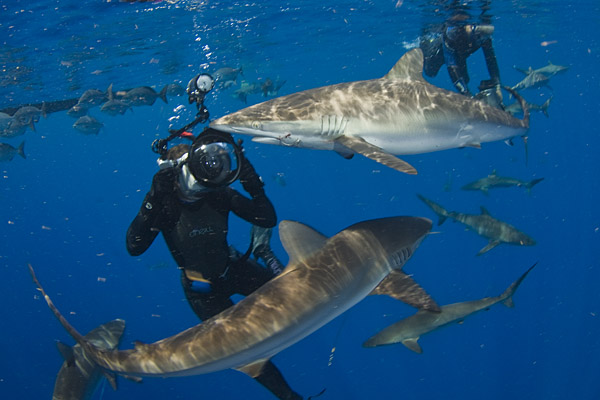
Claire and I immediately jumped in with our cameras which amazed the crew who see these sharks every day but live under the impression that anyone dumb enough to fall overboard would be consumed in an instant. Within a short time they developed a much better understanding of the nature of sharks and by the end of our time in the water they actually wanted to join us but we discouraged this as they didn’t have wetsuits and the brush of a friendly silky shark on bare skin can result in some nasty abrasions.
Claire got some good silky shots and I in turn got some nice pics of her shooting away surrounded by sharks:

Below the silkies I spotted a new shark for me! Two spinner sharks were cruising below the melee, curious but too timid to approach the chum. Spinners are notoriously shy around divers and swimmers. It is ironic that the shocking aerial shots of enormous schools of sharks swimming past Florida’s busy beaches each summer are mostly pics of migrating spinners which wouldn’t dream of harassing a beach goer.
They were impossible for me to approach but I fired off a few frames from a distance and the resulting i.d. shots are grainy but better than I thought they’d be.

While on the rigs the crew threw in their bottom fishing gear and brought up an interesting assortment of fishes. Some of these ended up in the pot but being ‘veggies’ Claire and I didn’t sample any of them. The highlight for us was a Gulf of Mexico smoothhound shark which we photographed from every angle before releasing it under the rig.


Tomorrow morning it will all be over. Captain Underwood and his crew David, Jack and Ron will go back to fishing for red fish and grouper, Eric and his assistant Jenifer will return to their lab, Film Maker Ulf Marquardt will fly back to Cologne to edit his documentary and Claire and I will drive down to Port Charlotte in southern Florida to pick up our (hopefully fixed up) camper van and head to the keys to chase stingrays and nurse sharks. But, this adventure will live on as one of the highlights of the North American Shark Diving Tour.
For the sharks,
Andy Murch