Walking the Dog…. (shark)
September 25, 2009 by sharkdiverWalking the dog
August 1st 2009
Sorry for the long overdue update. My PC died and I have spent the last couple of weeks learning to speak mac.
After two very frustrating weeks in the Gulf of Mexico waiting for spare parts for our camper, we needed a shark fix. It had to be a good one too, not just a momentary glimpse of a fleeing nurse shark or a mad scramble after a bolting stingray. Unfortunately, uncooperative weather continued to thwart any attempts to head out to sea so rather than battle the elements we drove north to land locked Atlanta.
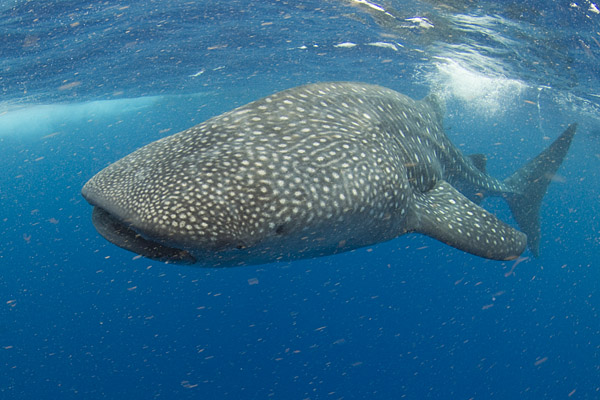
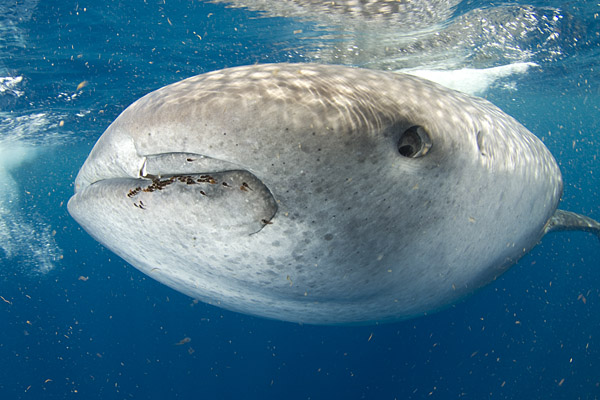
Now, at first glance Atlanta may not seem like a shark diving hot spot but a dip in the Ocean Voyager exhibit at the Georgia Aquarium is a quick way to tick off a dozen or more shark and ray species from your life list without even driving to the beach. And, if that in itself isn’t enough of a draw; topping the bill in the football field sized tank are four enormous whale sharks which were transported here from Taiwan in the bad old days before the Taiwanese banned the harvesting of whale sharks for consumption.
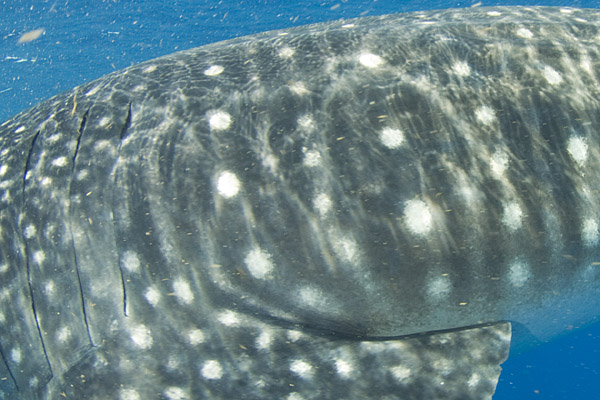
As whale sharks go, these ones are still relatively small but they are impressive never the less and with a regular diet of krill (or fish pellets that do the same job) they are growing fast. Sadly, two of the original sharks died from a reaction to an antibiotic but these have been replaced and all four of the present sharks appear to be in good shape.
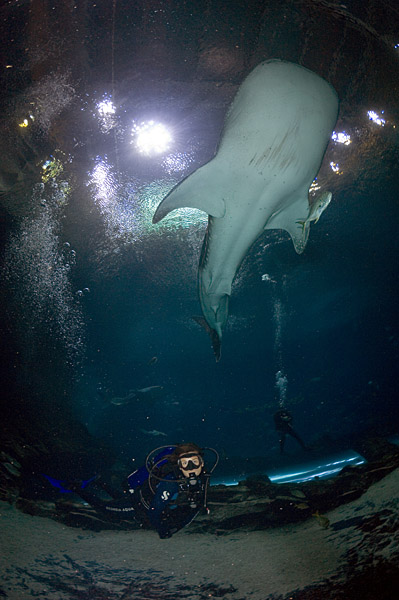

Claire and I listened intently to the dive briefings and watched the video that all potential divers get before entering the tank and then eagerly jumped into the crystal clear water and descended to the sand. As soon as our entourage of divemasters were happy with our buoyancy we drifted into the centre of the upper bowl of the tank. This half of the exhibit consists of a large shallow area devoid of obstructions where different species of sharks and rays can swim around unimpeded or sprawl on the bottom as they see fit.
While the other divers marvelled at the giants gliding overhead, I made a beeline for a large sawfish that was lurking on its own in the far corner. Sawfish absolutely fascinate me. How exactly they evolved to have an enormously long rostrum studded with wicked looking spikes is beyond me.
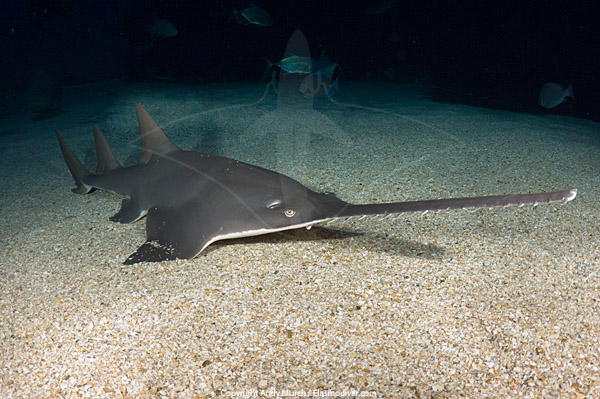
Unfortunately, their saws which they use to slash into schools of fish when feeding, have also become their downfall. Sawfish often get inextricably tangled in fishing nets and even if the nets are recovered before the sawfish die, many fishermen would rather kill them than risk injury trying to extricate them unharmed. There are also a few unscrupulous fishermen that actually target sawfish and hack off their saws to sell as curios on the black market. Consequently, they are now critically endangered worldwide.
There are two species of sawfish in the Atlanta Aquarium: green and largetooth. The largetooth sawfish are impressive in their own right but the green sawfish are impossible to ignore. Under the soft lights of the tank they appear to radiate a subtle golden light.
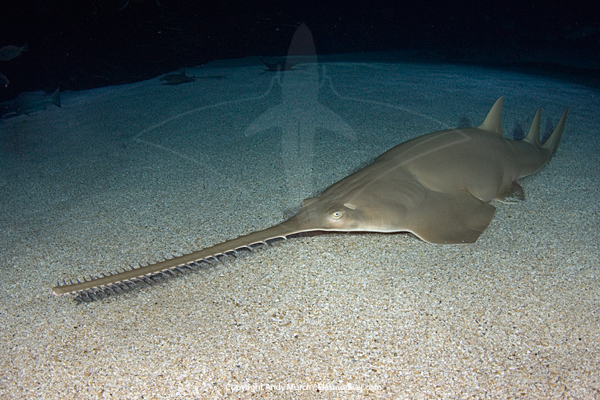
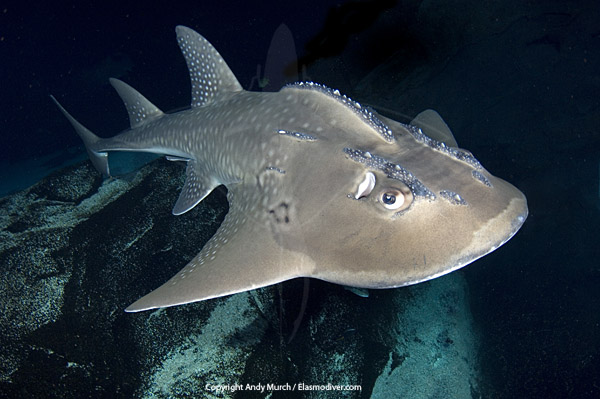
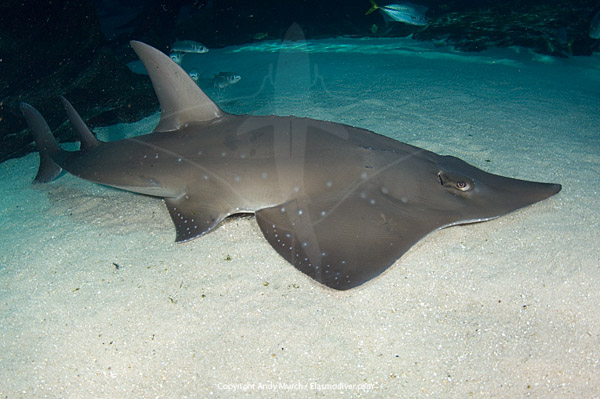
Sawfish are not the only large rays in the tank. There are a number of alien looking bowmouth guitarfish and some enormous shark rays. All of these are accustomed to close encounters with divers and snorkelers so it is possible to plonk down on the sand right next them and really study them in detail; not something that is easily accomplished in the wild.
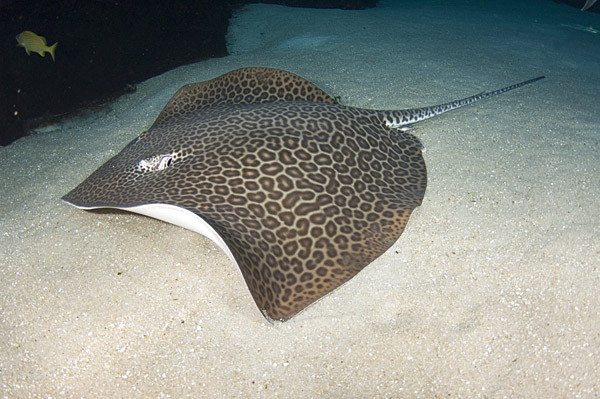
Other rarities include fantastically patterned leopard whiptail rays which I have tried to shoot in the wild in Australia but could not get anywhere near before they exploded away in a cloud of sand, and southern stingrays, pink whiptail rays, small groups of cownose rays and amazingly, a manta ray!

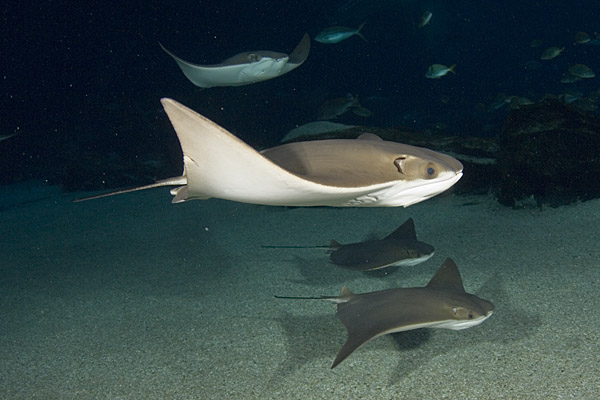
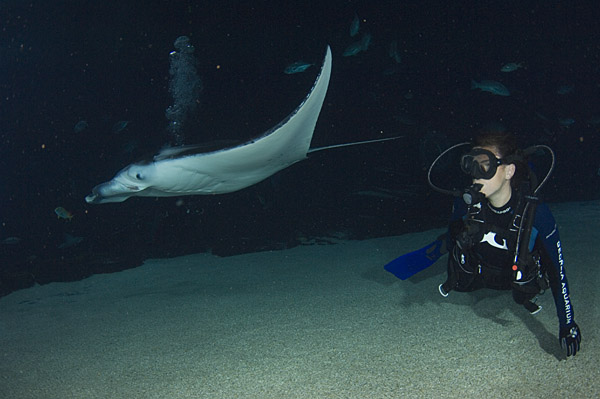
As for sharks, during the dive we were regularly buzzed by great hammerheads, zebra sharks and sandbar sharks. Sandtigers floated around as only sandtigers can and a number of wobbegongs (both tasselled and spotted) sprawled lazily on rocks and on the acrylic tunnels that were full of wide eyed spectators.

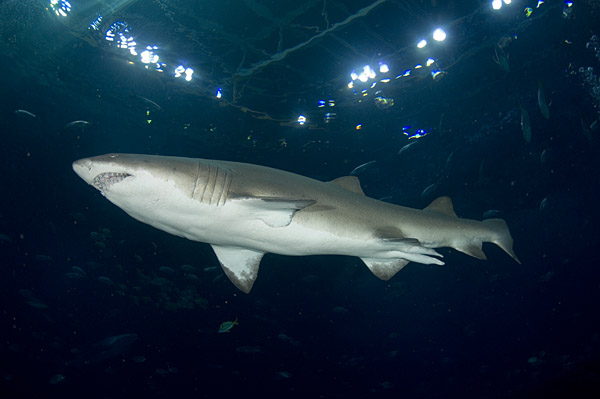
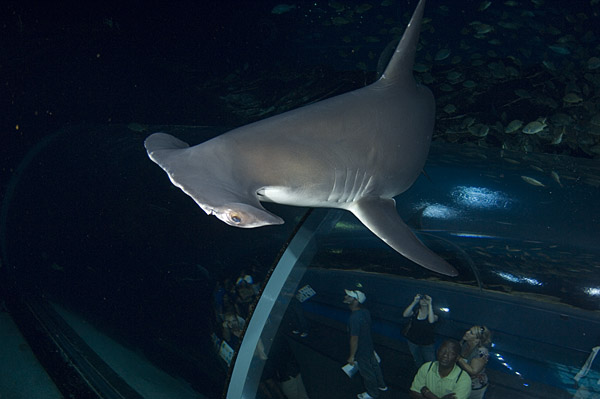
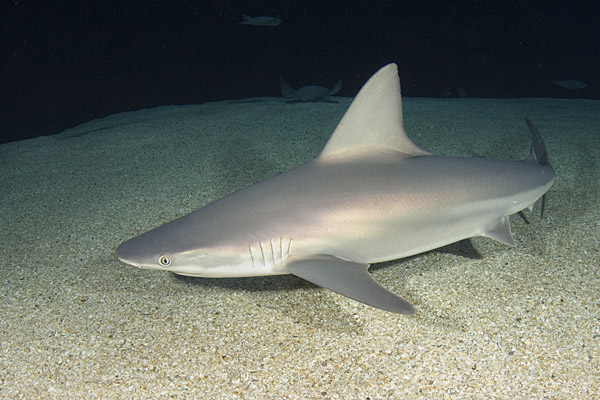
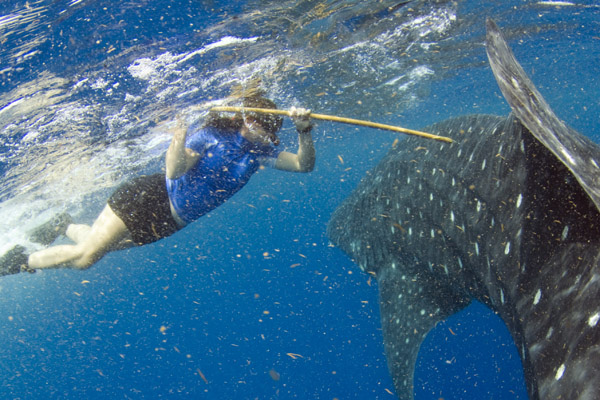
After snapping away in the upper bowl for a while we drifted down into the deeper half of the tank and checked out some of the sharks and rays that prefer to stay in that area. As instructed, we did our best to remain in the lower third of the water column so that the whale sharks could swim around in peace. Occasionally, one would swim by quite closely, perhaps to check us out, but for the most part the whale sharks stayed at the surface where they could cruise in long straight lines without interruption. The tank was designed so that the whale sharks have enough room to turn, swim towards the far end of the tank for a while and then glide for a bit. Studies of other aquarium sharks have shown that this is important because the sharks do better if they can rest for a short time before they have to turn again.
The whole time that I was swimming around I was trying to gauge whether the tank’s inhabitants were suffering from overcrowding. I’m still not totally sure but I didn’t see any sharks or rays trying to avoid each other by sudden directional changes. In fact the only time that any of the animals moved quickly was when I invaded their space. Also, very few of the animals had grazes on their noses or pectoral fins which would be a sure sign that they are having trouble swimming or are generally not comfortable in the tank.
With so much to look at it is not surprising that the dive was over long before we were ready to surface. We reluctantly exited the tank and cleaned up. The staff then presented us with goody bags full of sharky stuff and we sat down with Dr Bruce Carlson who filled us in on some of the research that the aquarium funds.
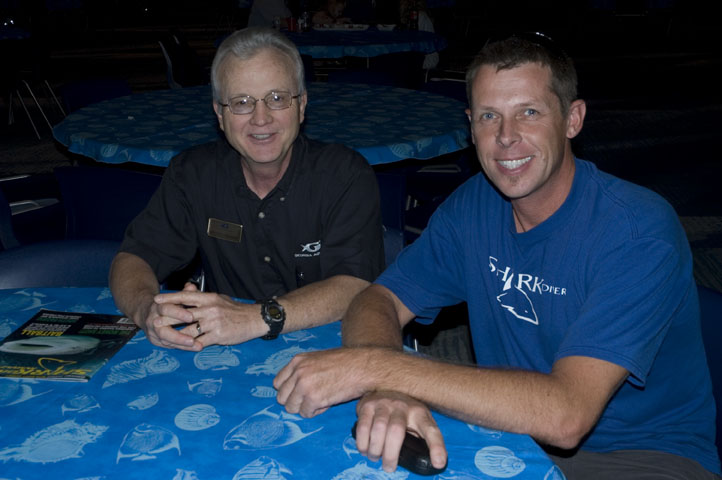
The Georgia Aquarium is involved with a number of projects including a long term study of the yearly whale shark aggregation near Holbox, Mexico, which is the largest known annual gathering of whale sharks in the world. In conjunction with Bob Hueter from Mote Marine Laboratory in Florida, the aquarium has been tagging and measuring as many whale sharks as possible each summer to try to determine where they migrate to, how fast they grow and many other unanswered questions. Dr Hueter is expected to publish his findings shortly.
We spent the rest of our day roaming the halls of the aquarium and people watching. Whether you’re pro-aquarium or not there is no denying how engrossed everyone was with the shark tank and that is a lot better than seeing people drawn to a large shark carcass hanging from the gallows on a fishing pier.
Armed with a fist full of new species we hopped in the shark bus and drove north.
Because of the van delays we had to skip NC with it’s famous sandtiger shark dives but thank you to Outer Banks Diving for the invitation. Next time we’ll get there even if we have to hitch hike!
From Georgia we drove straight to New England to look for skates. We spent a fun week exploring the New England coastline in search of skates but our time in Rhode Island is a hilarious story in itself. This is what I jotted down at the time:
WALKING THE DOG
In the quest to photograph rare and endangered sharks and rays I have found myself in some unusual situations. I’ve jumped off research vessels into racing currents, snorkeled down rivers and hitched rides on commercial fishing boats. Today however, I took part in one of the funniest shark shoots I will probably ever have.
Claire and I are in Rhode Island staying with Joe Romeiro who’s latest short film Death of a Deity recently won him the ‘Best Emerging Film Maker Award’ in the Blue Underwater Film Festival.
Joe is a self confessed shark fanatic. His house is a shrine to everything sharky, complete with a large tank that holds a variety of small sharks that Joe has rescued from fishing nets and cramped home aquariums and is in the process of rehabilitating.
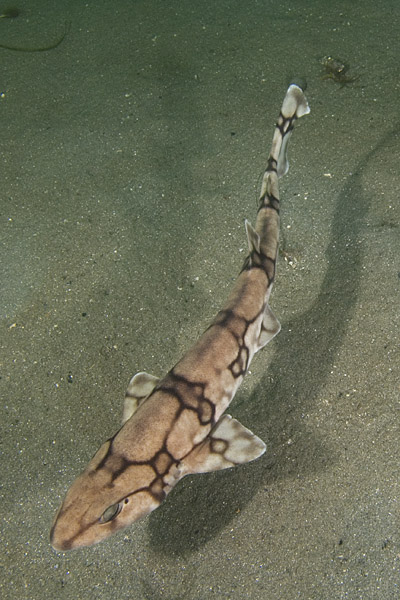
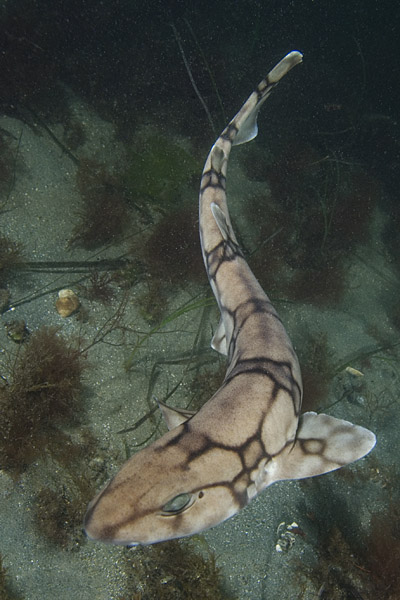
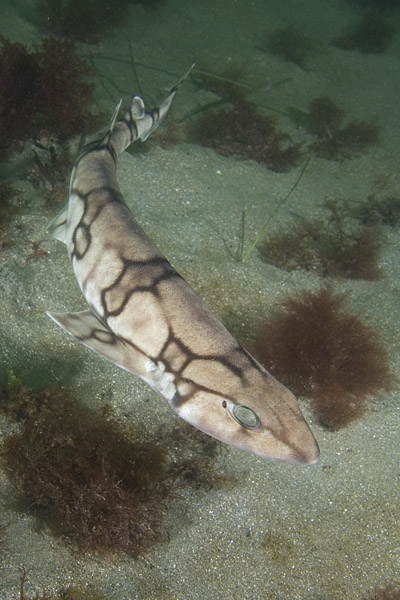
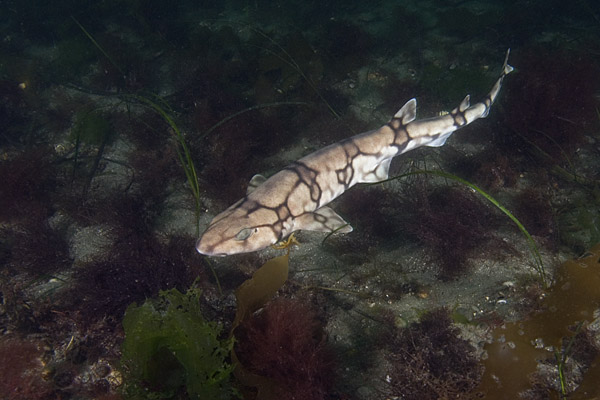
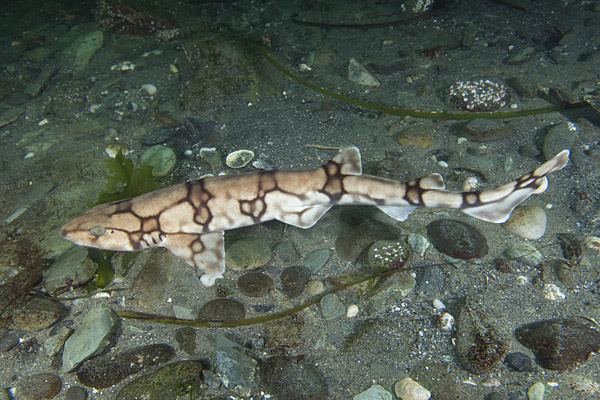
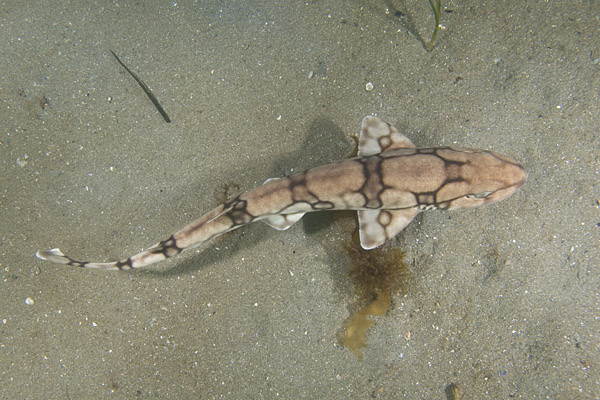
When I told Joe that one day we hoped to photograph a chain dogfish which is a beautiful little catshark that lives all along the east coast from New England to the Caribbean, Joe suggested that we take one of his recovering chain dogs for a walk at the beach. Initially, I thought he was joking but the more we talked about it, the less hair brained the idea seemed.
Chain dogfish (Scyliorhinus retifer) normally live at depths between 200ft and 2000ft making them virtually inaccessible to all but the most experienced tech divers. I have heard of tech heads diving really deep wrecks in the Carolinas that are literally teaming with chain dogs but without a rather lengthy and expensive trimix course there isn’t much chance that I will see one any time soon.
While we thought about the idea we did a little shore diving, partly to try to photograph some of the skate species that live off Rhode Island and partly to find a nice site that would be a suitable spot to walk the dog. King’s beach near Newport turned out to be ideal. It was close enough to Joe’s house to so that the hardy little shark wouldn’t have any trouble with the journey and it has some nice varied terrain offering us a choice of back drops for the shoot.
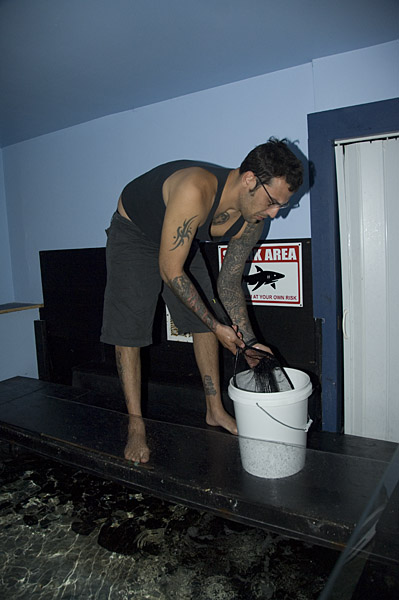
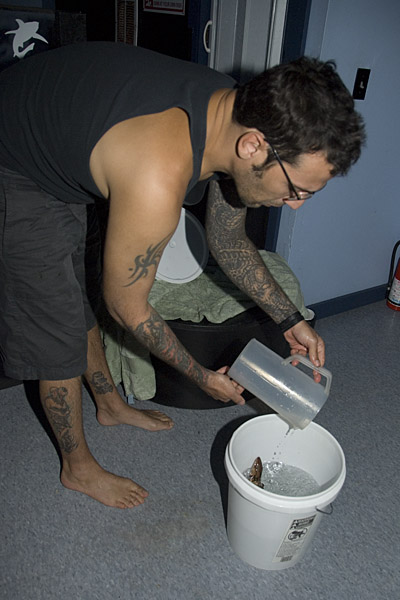
We waited till late afternoon when the sun would be the least stressful to the deep water shark and with everything prepared, Joe scooped up the tiny chain dogfish (that we affectionately named Steve) and lowered him into a bucket just big enough to keep him comfortable without letting him slosh around on the windy roads. Joe then transferred Steve (in his bucket) into his girlfriend Emma’s SUV and we began the zip across town to Kings Beach.


I confess that we probably bent a few traffic laws to make sure that Steve didn’t spend too long in his cramped environment but being a buccal ventilator (able to suck in oxygen rich seawater without having to swim forward) the tiny catshark would probably have been fine for hours.
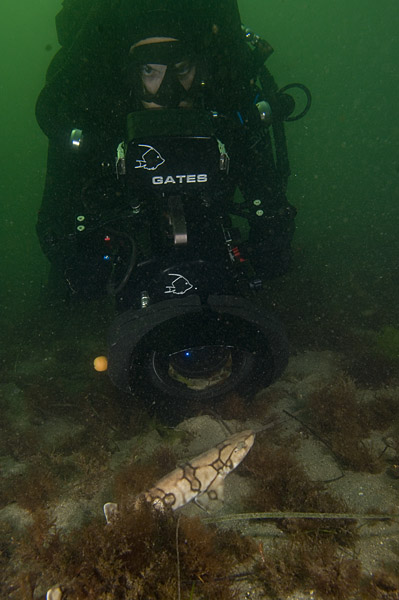
At the beach the three of us raced to get our gear on while Emma carried Steve down to the shallows and lowered the bucket into the sea to let the water temps equalize. Some curious tourists asked what we were doing with all the cameras so we said that we were going shark diving. They asked rather nervously if there were many sharks in these waters but we said “No, we brought our own” which left them with baffled looks on their faces.

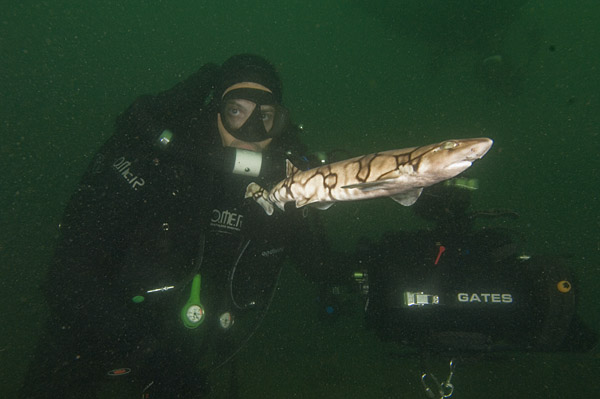
It was a comical site as the three of us stood in waist deep water waiting for the shark to be released. After some discussion on how best to liberate Steve I reached into the bucket and scooped him up in one gloved hand and swam slowly into clearer water where we could follow him if he decided to bolt.
As soon as he was released he sensed freedom and shot skyward then drifted back towards the sea bed with us in hot pursuit. For a few seconds it looked as though Steve was going to disappear into the depths but before long he got used to his enormous escorts and swam slowly around while Claire and I took pictures from every angle.


Once we were happy, Joe took over with his video camera and filmed some beautiful sequences of the exquisitely patterned catshark swimming over the reef.
Claire and I headed back to shore to give Joe a little more space. Emma was waiting in the shallows with the bucket and before long Joe materialized with Steve swimming ahead of him. Every now and then he would put a hand near Steve’s left or right side to keep him pointed in the right direction. As they reached the shore Emma dropped the bucket back into the water and deftly scooped up Steve who seemed none the worse for wear.

We drove water logged back to Joe’s house and quickly slipped Steve back into his tank with the other sharks which are in various states of rehabilitation. Periodically, Joe and Emma checked to make sure that the chain catshark was doing ok and the last report we got was that Steve was behaving as though nothing had happened. I imagined the conversation in the shark tank that night “Guys, you’re never gonna believe what happened to me… “
Considering the condition that Steve was in when Joe first got him, he is now in great shape so the next time that Joe decides to walk the dog it will be a one way trip. He plans to choose a site where there is a drop off close to shore so that the shark can find its way into a deep water without too much effort.




After New England we had just enough time to drive up to the Bay of Fundy to board the Storm Cloud. We were racing to join a Porbeagle tagging trip with Sharks Unlimited and our friends from UNB. It was a one shot deal and because it was a bit early in the season we struck out. This was my third year with the Porbeagles and I have some pretty good shots already so I was ok with that but Claire was on her first trip so she was pretty disappointed. A couple of days later the same thing happened in Baie Comeau. We could only allot one day to go after Greenland Sharks – strike two.
The moral of the story is that getting the shot is all about time in the water. If you can’t put in the time, you’ll probably go home empty handed. I’ve been telling other divers this for years but in reality I usually just get lucky. Lesson learned.
After a couple of days chasing gray seals around the Gaspe Peninsula we drove down to Toronto and took the van in for new tires and brakes. It was good timing because our next leg is a marathon drive to San Diego to look for smoothhound sharks, leopards again, soupfins, more blues, shortfin makos and California butterfly rays and then we will finish the tour in style by joining Lawrence Groth at Guadalupe Island to film Great Whites.
We stowed everything as best we could and took off for the border but unfortunately we got about 10km down the road and hit an enormous pothole on the freeway and nearly wrote off our camper.
We’re fine but our poor VW ended up back in the shop with two flattened rims, wrecked brakes, and a nasty oil leak that was rather worrying. This one hurt. Of course, it was Friday night before a long weekend – again!
It’s all fixed now and we’re finally on our way. The camper has a few more creeks and scrapes and a little more duct tape holding it together but we’re rolling. Hopefully our next blog will be from Southern California. First stop La Jolla. Come and join us if you’re down that way.
For the sharks,
Andy Murch