About Me

My photo
I am a Shark and Big Animal Photographer and the Founder of Big Fish Expeditions. I also pilot research submersibles on rare occasions but primarily I photograph sharks and rays. The shark images that I take have been used in many commercial publications but most importantly I try to concentrate on shooting rare and endangered species of sharks for conservation initiatives. It is a labour of love.
Showing posts with label silky shark. Show all posts

Sunday, December 20, 2009

Shark Pictures, Shark Projects and maybe a Shark Photography Workshop

Shark Pictures, Shark Projects and maybe a Shark Photography Workshop

November 30, 2009 by sharkdiver

The 2010 Central American Predators in Peril Expedition is taking shape. This will be the most exciting project that Elasmodiver has ever been involved in. If you thought that the 2009 North American Shark Diving Tour was ambitious, please have a quick look at the itinerary for the 2010 expedition. Its all laid out on the new Predators In Peril page on Elasmodiver.com
To quickly outline the mission: Beginning in early May, we will be traveling through nine countries along the entire length of Central America to photograph new species of sharks. We have arranged to work with local researchers in many locations and we will also be working with artisanal shark fishermen and with a number of Central American dive operators.
We are hoping to photograph at least a dozen new species that have not yet been documented in the wild. The images will be used in an extensive public awareness campaign and then offered to regional conservation groups to promote local conservation initiatives.
We have put in a couple of funding proposals but we still need help with equipment and field expenses. Please take a look at the Predators in Peril Expedition Wish List if you think you may be able to help. And, please spread the word about the expedition through any networks that you are involved with. Media coverage is a very important part of the project.

TIGER BEACH
In other news, I have just returned from Tiger Beach in the Bahamas. It was an unexpected last minute shoot that I almost didn’t go on but I’m glad I did because the sharks were VERY friendly on this visit and the shooting opportunities were outstanding. If you’ve never been to Tiger Beach you’d be forgiven for imagining a palm fringed island surrounded by big striped sharks but TB isn’t actually a beach at all. It’s a sand bank in the middle of nowhere that rises to within about 20ft of the surface. The lemon sharks that patrol the area have become accustomed to the occasional dive boat passing through and the sound of an anchor chain rattling down to the seabed acts like an aquatic dinner bell.
For first time visitors it can be very daunting seeing a score of large lemon sharks circling just below the swim step but lemons tend to be pretty well behaved sharks. Tigers (in my opinion) are a little more unpredictable. The tigers usually show up in ones and twos but you never really know what Tiger Beach will dish out. I’ve heard of divers encountering a dozen tigers on a single dive. I’m sure that would be fun for the adrenalin junkies that go shark diving for kicks but it would make my job a little tricky so I’m glad that we only saw a handful of tigers over the course of the week.
I need an accommodating shark that is bold enough to come in close and pose but doesn’t get out of control and swim off with the bait box. The 4 meter female that adopted us on this trip was almost the perfect shark. ‘Fluffy’ as we called her, was a beautiful animal that moved slowly among us for the better part of two days. Judging by her distended belly she was either digesting a turtle or almost ready to give birth to the next generation of baby tigers.
Between Fluffy and the omnipresent lemon sharks it turned into a great shoot:
http://elasmodiver.com/Tiger%20Shark%20Pictures.htm

MORE IMAGES ON ELASMODIVER
After Tiger Beach I had a week to kill in Florida which would normally have involved lots of snorkeling with stingrays and hunting for little coastal sharks but I’m ashamed to say that I barely got wet even though I was holed up right next the beach in Fort Lauderdale. I spent the week sitting in a darkened hotel room cleaning and sorting all of the images that I have taken this year. It was a mammoth undertaking but I’m finally caught up (almost). Pretty soon there will be a whole lot of new images on Elasmodiver.com – I promise!
Here are some new leopard shark pics to keep everyone happy:
http://elasmodiver.com/Leopard%20Shark%20Pictures.htm

2010 SHARK SHOOT IN THE BAHAMAS
While in Florida I attended DEMA – the yearly North American Dive Industry Bash. I’m glad I went because after 4 days of schmoozing with magazine editors and dive operators I walked away with lots of exciting plans for next year. So many plans in fact that there is no way I can work on them all, but even if I make half of them happen it is going to be an amazing 2010.
One tentative plan I have is a Shark Photography Workshop in the Bahamas. This is a new direction for me. Other professional shooters have done similar workshops but I have been biding my time until I was sure I had something worth offering.
Now I’m ready. We’re looking at a 3 or 4 day shoot, mostly working with Caribbean reef sharks in different environments. Two dives a day plus ‘how to’ workshops, photography critiques (don’t be shy) and daily slide shows.
The idea is that you walk away with some good pics, a better understanding of how to shoot sharks and some great stories about the crazy time you had with a slough of other shark shooters in the Bahamas. Space will be limited so if that sounds like fun let me know! Depending on interest, I’m hoping to set some dates in April before the Predators in Peril Expedition gets underway.

NEW ELASMO T-SHIRTS!
Another spin off from DEMA, I bumped into Tom Sergent who operates the company Amphibious Warrior Scuba Wear which raises money for shark education and conservation activities. Tom is a big supporter of Elasmodiver and he has agreed to produce our new Elasmo T shirts that have been getting rave reviews. His new AWSW website will soon be up and running but for now, if you want to order an Elasmo T, go to Tom’s AWSW fan page on FaceBook:
Amphibious Warrior Scuba Wear on Facebook
The Elasmo T’s are US$22. All proceeds go towards the Predators in Peril Project:

BAIT BALL DIVING IN THE SEA OF CORTEZ
Tomorrow I leave for Cabo san Lucas in Baja to shoot Marlins with Shark Diver Magazine. “MARLINS?” I hear you say. Well, its a trip to shoot marlins attacking bait balls. Don’t tell the editor but I’m only going incase some sharks show up to feed as well. If they do, I’ll just have to wait for those pesky marlins to get out of the way so that I can get the shot.

For the sharks,
Andy Murch

The Shark Tour Blogs: Gulf of Mexico Whale Sharks

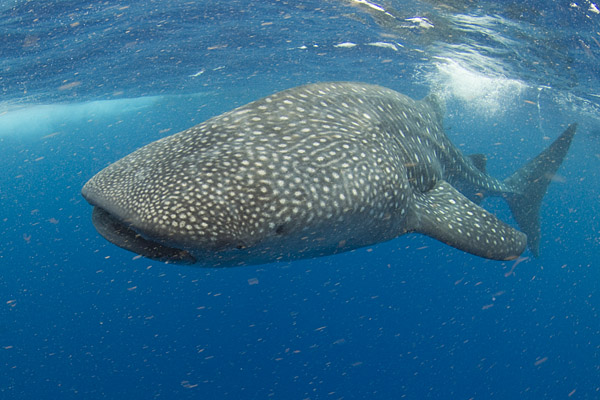
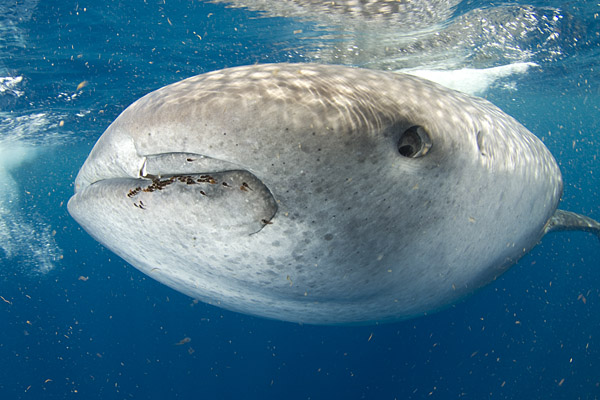
Tagging Whale Sharks in the Gulf of Mexico

September 25, 2009 by sharkdiver

Tagging Whale Sharks in the Gulf

14th June 2009

We are aboard the 67ft commercial fishing vessel Norman B which operates out of Leeville, Louisiana. The Captain/owner of the ship – Russell Underwood – has a deep fascination with the ocean that he has been sailing over for the last three decades. Last year he and his crew witnessed some large aggregations of whale sharks in which upwards of 100 animals came together to feed at fish spawning events around the northern gulf. Awe struck by this amazing sight he was inspired to hang up his fishing gear for a week and invite our gang of researchers and film makers on an expedition to record and tag the behemoth sharks.

Over the past seven days we have witnessed around a dozen whale sharks feeding on dense floats of fish eggs which Dr Eric Hoffmayer will eventually identify once he returns to his lab in Ocean Springs, Mississippi.

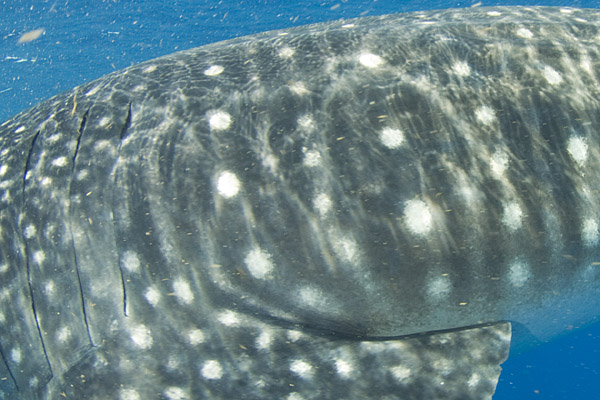
Claire and I were invited aboard to take i.d. shots of the sharks for the Ecocean inititive. This is an international database of individual whale sharks that have been positively identified by recording the unique spot patterns that occur behind the whale sharks left gill openings.

The composition of the markings in this area does not change significantly as the animal grows so it acts like a thumb print that can be entered into a program that utilizes stellar mapping software to match up images taken at different times and places. Potentially, this can be used to track the movements of whale sharks without using expensive (and invasive) acoustic or satellite tags.

We also had three sat tags on board that Eric was able to place on the sharks. In 8 or 9 months time these devices should detach, float to the surface and transmit their data to any satellites that are passing by.

On the third day I managed to crack a rib while pulling myself back into the chase boat. If memory serves that is my 15th broken bone which is a pretty sad testament to my clumsiness or maybe I simply end up in harm’s way more than most people. Either way, it made for some painful days and nights and didn’t help my struggle to keep up with the sharks.

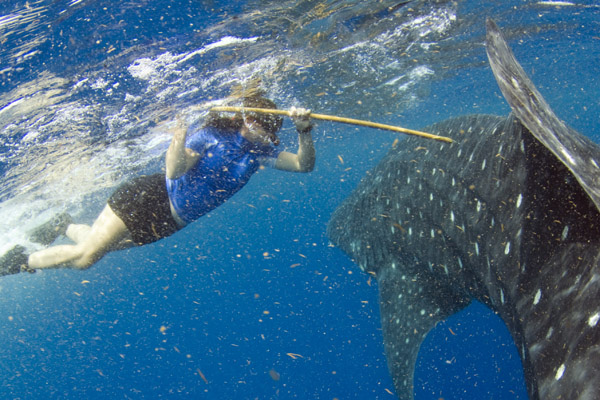
After we deployed all the sat tags we decided to spaghetti tag the other sharks so that we could tell which ones we had already swum with because one enormous spotted shark looks surprisingly like another. I stayed on thumb print photography duty but Claire actually got to tag a 25ft whale shark which she managed to deftly accomplish on the first attempt.

When you’re motoring across it, the gulf is a seemingly endless body of water and although whale sharks are the biggest fish in the sea, searching for them is like looking for the proverbial needle in a haystack. To find them we cruised along one tide line after another but you can only stare at blue water in search of fins for so long before you start to go bug eyed.

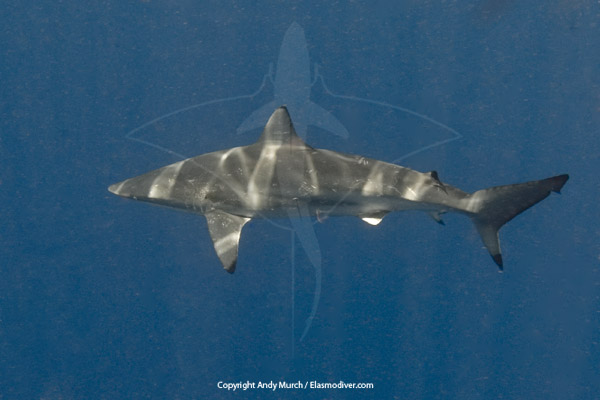
To break up the monotony, every day we tied up to one or two of the 5000 oil rigs that are sprinkled along the continental shelf. We wanted to chum up some predatory sharks that Eric was also interested in tagging. I think we were all surprised that at most of the rigs the sharks were a no show but at one particular spot we finally encountered a nice assortment of silky sharks.

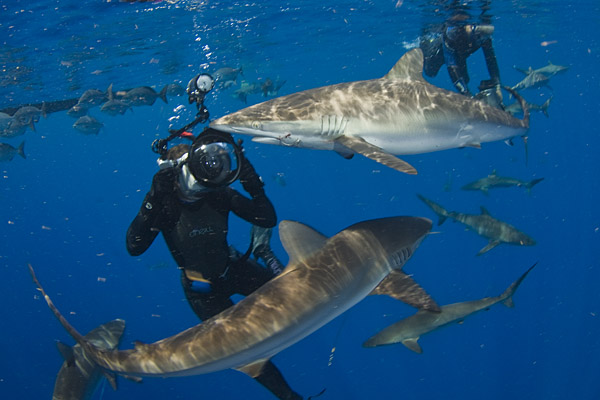
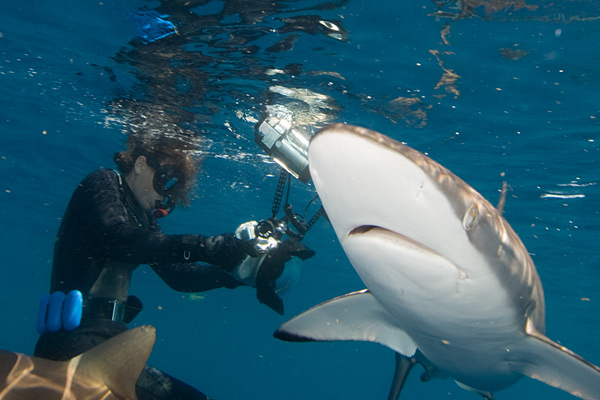
Claire and I immediately jumped in with our cameras which amazed the crew who see these sharks every day but live under the impression that anyone dumb enough to fall overboard would be consumed in an instant. Within a short time they developed a much better understanding of the nature of sharks and by the end of our time in the water they actually wanted to join us but we discouraged this as they didn’t have wetsuits and the brush of a friendly silky shark on bare skin can result in some nasty abrasions.

Claire got some good silky shots and I in turn got some nice pics of her shooting away surrounded by sharks:

Below the silkies I spotted a new shark for me! Two spinner sharks were cruising below the melee, curious but too timid to approach the chum. Spinners are notoriously shy around divers and swimmers. It is ironic that the shocking aerial shots of enormous schools of sharks swimming past Florida’s busy beaches each summer are mostly pics of migrating spinners which wouldn’t dream of harassing a beach goer.

They were impossible for me to approach but I fired off a few frames from a distance and the resulting i.d. shots are grainy but better than I thought they’d be.

spinner shark

While on the rigs the crew threw in their bottom fishing gear and brought up an interesting assortment of fishes. Some of these ended up in the pot but being ‘veggies’ Claire and I didn’t sample any of them. The highlight for us was a Gulf of Mexico smoothhound shark which we photographed from every angle before releasing it under the rig.

Tomorrow morning it will all be over. Captain Underwood and his crew David, Jack and Ron will go back to fishing for red fish and grouper, Eric and his assistant Jenifer will return to their lab, Film Maker Ulf Marquardt will fly back to Cologne to edit his documentary and Claire and I will drive down to Port Charlotte in southern Florida to pick up our (hopefully fixed up) camper van and head to the keys to chase stingrays and nurse sharks. But, this adventure will live on as one of the highlights of the North American Shark Diving Tour.

For the sharks,

Andy Murch
The Shark Tour Blogs: Gulf of Mexico Silky Sharks and Atlantic Sharpnose Sharks

Gulf of Mexico Sharks

September 25, 2009 by sharkdiver

Gulf Sharks

15th May 2009

The west coast and even Texas is already starting to blur. We are now driving around the Florida Panhandle looking for bluntnose and Atlantic stingrays to photograph. The last time I looked for stingrays here was way back in the point and shoot days long before I decided to become a ’serious’ photographer.

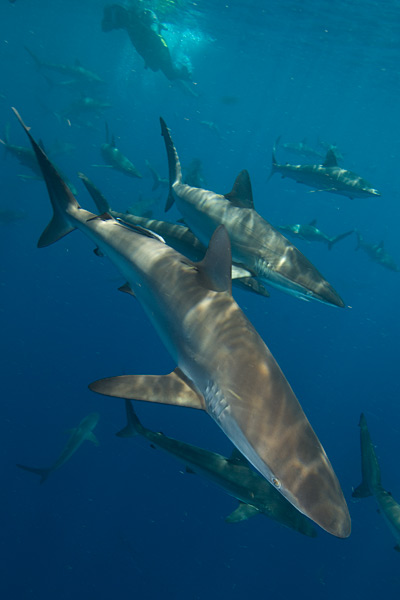
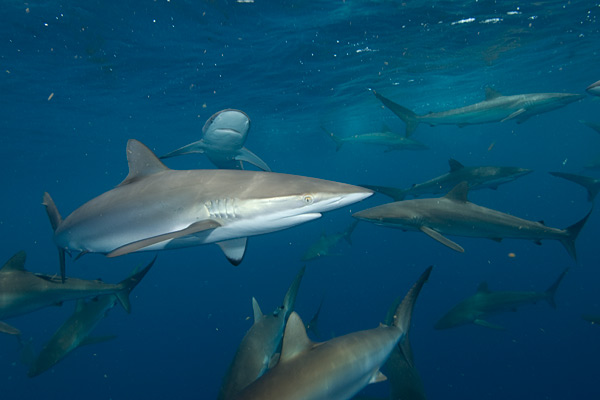
Last weekend we made the pilgrimage to Venice to dive with silkies and duskies. The duskies obviously didn’t get the memo but the oil rig that we dove at had so many silky sharks swimming around it that it was hard to remember that most shark species are endangered. For more than an hour we snorkeled around the boat in the presence of 100 or more sharks. The water was warm, the viz was great and the sharks were very, very friendly!

Venice is such a sharky place that it was the perfect location to reconnect with Eli, Paul and Nathan from Shark Diver Magazine. After two years apart we had a lot to catch up on and this was my first chance to introduce Claire to the team. Good times, good diving and some pretty good silky pics!

After Venice we drove east to the Gulf Coast Research Laboratory in Ocean Springs, Mississippi to meet with Dr Eric Hoffmeyer. Each month Eric and his team venture into the Mississippi Sound to monitor the shark population. The sound is home to thousands of small sharks, predominantly Atlantic sharpnose sharks but also finetooth sharks, bulls, blacktips, bonnetheads and a variety of other species.

Eric has collected a wealth of data on the sharks that migrate into his domain each summer and over two days out at sea I was able to sit and soak up more shark science than I ever thought my tired brain could handle.

Eric was kind enough to halt his work long enough for us to jump into the muddy water to photograph the sharpnose sharks that he released. The visibility was horrendous (about 3 to 4ft) but some of the images that we managed to get are surprisingly clear. One more shark to add to the Elasmodiver Field Guide at the end of the tour.

The majority of sharks that are landed are tagged, measured, fin clipped, blood sampled and swiftly returned to the sound but a few of the sharks that come up the line are DOA. These are brought back to the lab for further analysis and Eric invited us to join him in the lab to document the dissection process. It was a side of shark research that I haven’t been exposed to very much and it was a bit gory but fascinating to watch this aspect of his work.

After our Florida leg we are planning to head back to MS to work with Eric again.

For the sharks,

Andy Murch